 Students Incorporated
Creativity
Be Chanida Turned a Lost Suitcase Into Her Best-Known Series
Bangkok painter Be Chanida built her career on Instagram, not galleries. A studio visit reveals how a lost suitcase in New Zealand became her best-known series.
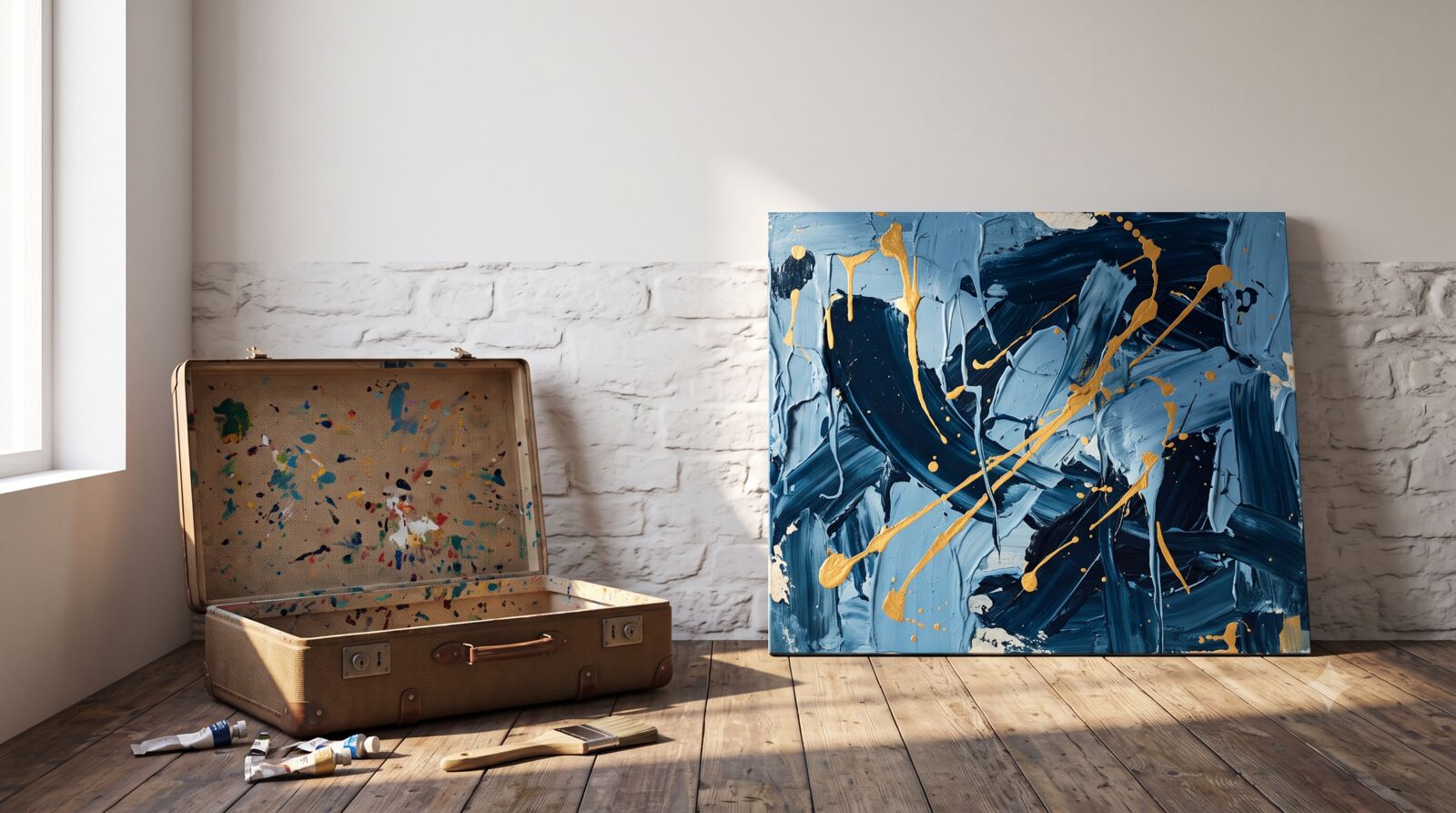
Bangkok painter Be Chanida has never signed with a gallery, and her most acclaimed painting series exists only because her luggage went missing on a trip to New Zealand. Those two facts, both volunteered during a recent class field trip to her studio, explain most of how she works.
Students from Students Incorporated, the podcast produced by students at the International Community School of Bangkok, had interviewed Chanida once before, in the show's own studio. This time they came to hers: a studio down a Bangkok soi so narrow their bus could barely park, forcing the group to walk the last stretch on foot. What they found inside was less a gallery than a working record of years spent teaching herself, in public, how to paint without a plan.
The Suitcase That Started Everything
Chanida's most extensive body of work, a series she calls "Necessary Unnecessary," began with a logistics failure. She had flown to New Zealand's South Island and booked an eleven-day campervan trip, only to have her luggage go missing en route. Stripped of the gear she'd packed for both the drive and a planned ski excursion, she spent, in her words, several days simply furious about it, unable to stop replaying what she'd lost and hadn't been able to replace.
The break came when she let it go. Rather than keep mourning the missing bag, she turned the experience into paint: a series built entirely around the question of what a person actually needs versus what they only believe they need. "People can live less," she told the students, "but we never try." It's a line simple enough to sound like a proverb, but she arrived at it the hard way, stranded in a rented campervan with nothing she'd planned to bring.
The series has since grown to roughly twenty large-scale canvases, with more added most years. One of the pieces on view during the visit, a 120-by-150-centimeter work from the series, was priced at 180,000 baht, and Chanida mentioned an even larger 400-centimeter canvas as among the biggest she's completed. She isn't precious about scale for its own sake; she said she works best standing, using her whole arm, and that a client who once asked her to paint something smaller left her stuck for two weeks, unable to adjust to working seated at a table.
No Dealer, Just Instagram and a Doorbell
For most of her career, Chanida has operated without gallery representation, and she was matter-of-fact with the students about why: exhibitions and buyers found her first, through her Instagram account, not the other way around. She used to let interested buyers come to her house directly after seeing her work online, until the volume of visitors made that impractical and she opened a proper studio instead. Only after that did galleries start approaching her.
It's a path more artists are choosing on purpose. A widely cited 2018 Artsy analysis of artists selling directly to collectors on Instagram found that traditional dealers typically take a 50 percent cut of any sale, compared with keeping the full amount when a collector buys straight from the artist's own account, a gap wide enough that some working artists interviewed for that piece said they'd turned down gallery representation specifically over the terms attached to studio sales. Chanida's own account, given independently of that reporting, tracks the same logic: she built an audience and a client list before any dealer was involved, and the exposure did more for her prices than a gallery wall might have.
She's kept some of that independence even now that galleries do call. She told the group she generally avoids commissioned work altogether, arguing that an expressionist painter draws from an internal, unrepeatable state ("it come because of me, only me," as she put it), and that a buyer who loves a finished piece and asks for a version in a different size is asking for something she can technically produce but that she believes they won't actually love the same way. Twins, she said, aren't a substitute for the child you already have.
People can live less, but we never try.
One Sitting, No Revisions
Chanida's process resists the idea that a painting develops in careful stages. She described most of her large-scale abstract works as effectively finished in a single sitting, a single day, precisely because her method is rooted in expressionism: she needs to capture a feeling while she's still inside it, not return to it later with a cooler head. Where representational painting can be reworked over weeks, she said her pieces either arrive whole or get painted over and abandoned.
That same instinct shows up physically in her studio. For one recent body of work, she laid raw canvas on the floor and painted while walking across it, chasing a looser, more physical mark-making than an easel allows. She uses the unprimed back of the canvas rather than the gessoed front for some pieces, she explained, because the untreated fabric absorbs water and oil less predictably than a primed surface, producing blooms and bleeds she can't fully control, which is the point. One painting from that floor work doubled as a comment on social media itself: brief, filtered glimpses of a life that never show what's underneath, the few edited seconds a viewer sees standing in for a much longer, messier story.
Even color, in her account, resists a fixed vocabulary. Asked what each color represents, she said meaning shifts by viewer as much as by intention: she is drawn to black because it reads to her as peace, while other people see the same black and read fear. That refusal to pin down a single interpretation extended to the students' own reactions in the room: one described a piece as reminding her of Iceland and quiet nighttime thought, another as looking like the Barbie movie's version of heaven, a third as capturing rage at an unfixed world alongside a thread of hope. All three were describing paintings from the same visit.
A Bangkok Art Scene Finding Its Audience
Chanida's trajectory, building a following and a client base online before institutions came calling, is part of a broader shift in the city's art world, not just her own workaround. Frieze reported in August 2025 that Thailand's contemporary art scene has been gaining international traction, pointing to new institutions like the roughly 6,000-square-metre Dib Bangkok museum, government-backed "soft power" initiatives aimed at growing the country's creative sector, and a widening base of private collectors and foundations investing in Thai and Southeast Asian artists. One of Chanida's own recent exhibitions, "Silence and Chaos," was staged at the Four Seasons ART Space by MOCA Bangkok, a rotating exhibition venue that the Museum of Contemporary Art Bangkok runs in partnership with the Four Seasons Hotel Bangkok to showcase local artists quarterly, exactly the kind of institutional platform that a decade of independent, Instagram-first work has now made available to her.
Walking students through that body of work, Chanida pointed to a related theme she calls "Transformation and Metamorphosis," including a piece she referred to as her Phoenix painting, built around the idea that people can be reborn multiple times across a life, provided they're willing to burn down an old version of themselves first. It's a thematically consistent extension of the same instinct behind "Necessary Unnecessary": deciding, deliberately and sometimes painfully, what to let go of.
Back on the bus afterward, the students who'd spent the morning describing paintings in their own words said the visit had changed how they thought about the work itself: not as finished objects to admire from a gallery bench, but as the visible residue of an artist's ongoing argument with herself about what actually matters enough to keep.