 Students Incorporated
Creativity
Why Atelier Pichita Designs Backward From the Fabric
Third-generation Atelier Pichita director Tatim on why scarce, hand-woven Thai silk means every garment starts with a fabric count, not a sketch.
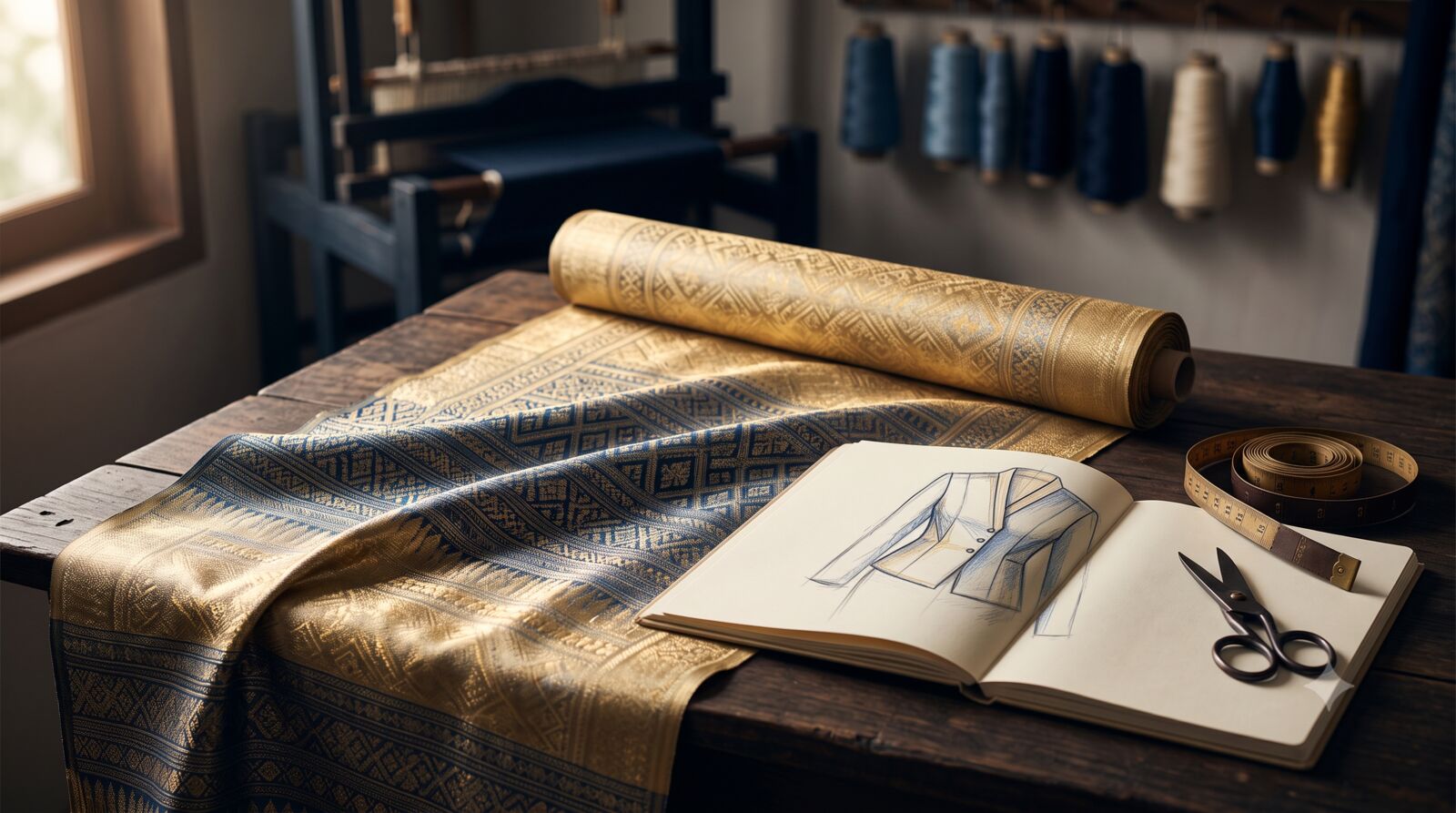
Most fashion houses design first and source fabric second. Atelier Pichita does it the other way around. Tatim, the brand's third-generation managing director, told Students Incorporated co-hosts Esther and Highlight that because the house's signature material, hand-woven Thai silk, can never be mass-produced, every collection has to start with a count of what fabric actually exists before anyone draws a sketch.
The design starts with a fabric count, not a sketch
Thai silk, Tatim explained, is slow and difficult to make by hand, which puts a hard ceiling on supply: "you cannot reproduce a thousand meters of the same Thai silk." That scarcity is a documented historical fact, not just a design constraint Atelier Pichita chose to embrace. Thai silk weaving dates back more than 3,000 years to the Isaan region, but cheap machine-made textiles nearly wiped out the handloom trade by the early 20th century; by 1947, when American businessman Jim Thompson began seeking out weavers to help revive the craft, the indigenous silk industry had almost entirely disappeared. Thompson's efforts (gathering weavers, upgrading looms, standardizing thread counts) rebuilt the industry into what exists today, but even after that revival, much of Thai silk production shifted toward mechanized factories, leaving genuine hand-loomed silk a comparatively rare, slow-to-produce material rather than something any studio can order in bulk. That scarcity forces the math to happen before the design does. Once a bolt of silk arrives, the studio has to work out what it can actually become: a full outfit, a single shirt, a skirt, or, if there isn't enough, just one sleeve. In her framing, each piece of silk is already an art object before the studio touches it, "another art piece needs to be made from that art piece," which is why the house calls its finished garments wearable art rather than simply clothing.
A childhood spent on the studio floor
The house traces back three generations. Tatim's grandmother worked as a dressmaker in Thai silk and made outfits for Miss Universe contestants. She passed the craft to Tatim's mother, Pichita, who studied in Paris and picked up the word "atelier" (used at houses like Christian Dior for a design workshop built around craftsmanship) and carried Thai silk further into lifestyle pieces. Tatim grew up inside that history literally: the family's office doubled as their home, and she describes playing with scraps of fabric on the studio floor as a child, absorbing the process by watching rather than through formal training: taking a client's brief, then shaping a design that fits both their body and their sense of identity. "We don't change the brand completely," she said of that approach, "but we meet in the middle."
The Golden Metamorphosis: roughly 150 pieces, two years
Asked which project she's proudest of, Tatim didn't point to a single garment. She pointed to the house's 45th-anniversary collection, "Golden Metamorphosis." The name, she said, draws on a Thai concept close to growing new skin: shedding what's old and becoming someone new while still remaining yourself. The collection took nearly two years to build: 54 pieces walked the runway, with almost 100 more made for the accompanying exhibition, for roughly 150 pieces in total, by her account one of the largest single projects the house has taken on. One exhibition piece stuck with a co-host who'd seen it in person: a firefly-themed costume built around glowing lights, made for a beach wedding and tailored specifically to that couple's setting, what Tatim called hyper-personalization.
Craftsmanship isn't fashion, and it isn't luxury either
Asked what matters most when working with artisans, Tatim named respect and patience first: understanding that these pieces aren't made the way anything off a rack is. From there she drew a distinction she said she first learned formally while studying luxury brand management in her master's degree: fashion chases trends and mass appeal and is, at its core, a volume business. Craftsmanship is about telling a story and refining what isn't yet perfect rather than chasing what's current. Luxury sits in between: staying authentic to what a house already does well while still adapting, rather than either freezing in the past or abandoning its core identity. "Craftsmanship is not fast," she said. "Fashion is fast."
The industry's real problem is speed
Asked about the hardest part of preserving tradition in a fast-moving industry, Tatim didn't hesitate: speed. Fast fashion, she said, is simply the default option for most people, and it sits at the opposite end of the spectrum from hand-loomed silk that takes real time and close attention to detail. Balancing survival in a market built for speed against a process that can't be sped up is, in her words, the house's central challenge.
The scale of what Tatim is competing against is enormous by design. Some fast fashion retailers can design, produce, and ship a new garment in as little as ten days to two weeks, turning out somewhere between 80 and 100 billion new garments globally every year. The environmental cost of that pace is significant: the fashion industry generates an estimated 92 million tonnes of textile waste annually, a figure researchers project will climb past 130 million tonnes by 2030, and accounts for roughly a tenth of global carbon emissions, more than international flights and shipping combined. A house that spends nearly two years on a single 150-piece collection isn't just working at a different pace than that system. It's operating on the opposite end of an industry-wide tradeoff between speed and waste that most of fashion has already resolved in favor of speed.
Looking a decade out, she said she'd like to see innovation aimed at supporting artisans' hand skills rather than replacing them, along with more patterns developed on Thai silk and more visibility for it globally. She tied that hope to sustainability, arguing that Thai silk, a natural fiber colored with natural dyes, is the kind of alternative the world needs to synthetic fabrics, which she said can be non-breathable and, in her view, carry health risks from the chemicals involved. The research on synthetic textiles backs up more of that concern than a casual claim might suggest. Polyester and similar synthetic fibers shed microplastics with every wash, contributing to an estimated half a million tons of plastic microfibers entering the ocean each year, and researchers have since detected microplastic particles in human blood, placental tissue, and other organs. Studies on synthetic textile workers have also linked heavy microfiber inhalation to respiratory disease, and polyester's comparatively poor breathability, next to natural fibers like silk or cotton, is well established as a factor in trapped moisture and skin irritation. Tatim's pitch for natural fiber isn't just brand positioning; it tracks with where the underlying research on synthetic fabric has actually landed.
Talent opens doors, discipline keeps you in the room
What she wants a customer to feel wearing a piece isn't just "I look good," Tatim said. It's confidence paired with the sense of carrying a story, one that supports a local artisan's livelihood and a house built on sustainable fabric and heritage.
Her advice to anyone hoping to enter luxury craftsmanship starts with being honest about whether you actually want it, then learning the fundamentals as a "ground base" before finding your own path within them. She drew a direct line to her own path: she originally studied multimedia design (graphic design, 3D web design) before finding her way back into the family craft, and she frames that early, broad exposure as the same kind of experience she'd recommend to anyone starting out.
Talent opens doors, but discipline keeps you in the room.
Host Mr. Jason closed the episode with a line that doubled as its thesis: style is temporary, but craftsmanship is forever.