 Students Incorporated
Technology
The Bangkok Studio That Bet Big on Touch, Not Screens
Shakes Bangkok co-founder Prompong Hakk predicted design's future was physical, not digital. Three years later, the data is split on who was right.
Industrial design spent the last two decades losing ground to a screen. Prompong Hakk, co-founder and creative director of the Bangkok design and engineering studio Shakes, thinks that's about to reverse, and his studio already built the chair to prove it.
Hakk, who co-founded Shakes with mechanical engineer Surakead Hemwimon roughly twelve years ago, spent part of a conversation on the Students Incorporated podcast diagnosing a stall that most people outside the design industry never notice. Manufacturing methods, injection molding and the basic mechanics of mass production, haven't meaningfully changed since the early twentieth century, he said, so product designers hit a ceiling. Digital design didn't have that problem. Screens could do more every year, so investment, talent, and attention flowed into UX and UI instead. "We've done amazing things digitally," Hakk said. "But it's just there on the screen. It's a lack of connection between our experience, our physical experience to it."
His prediction was specific: the next decade of design would be about reconnecting the two, building products that translate digital sophistication into something a body can actually feel. As evidence, he pointed to the project his own studio had just shipped.
The Chair That Shifts Gears
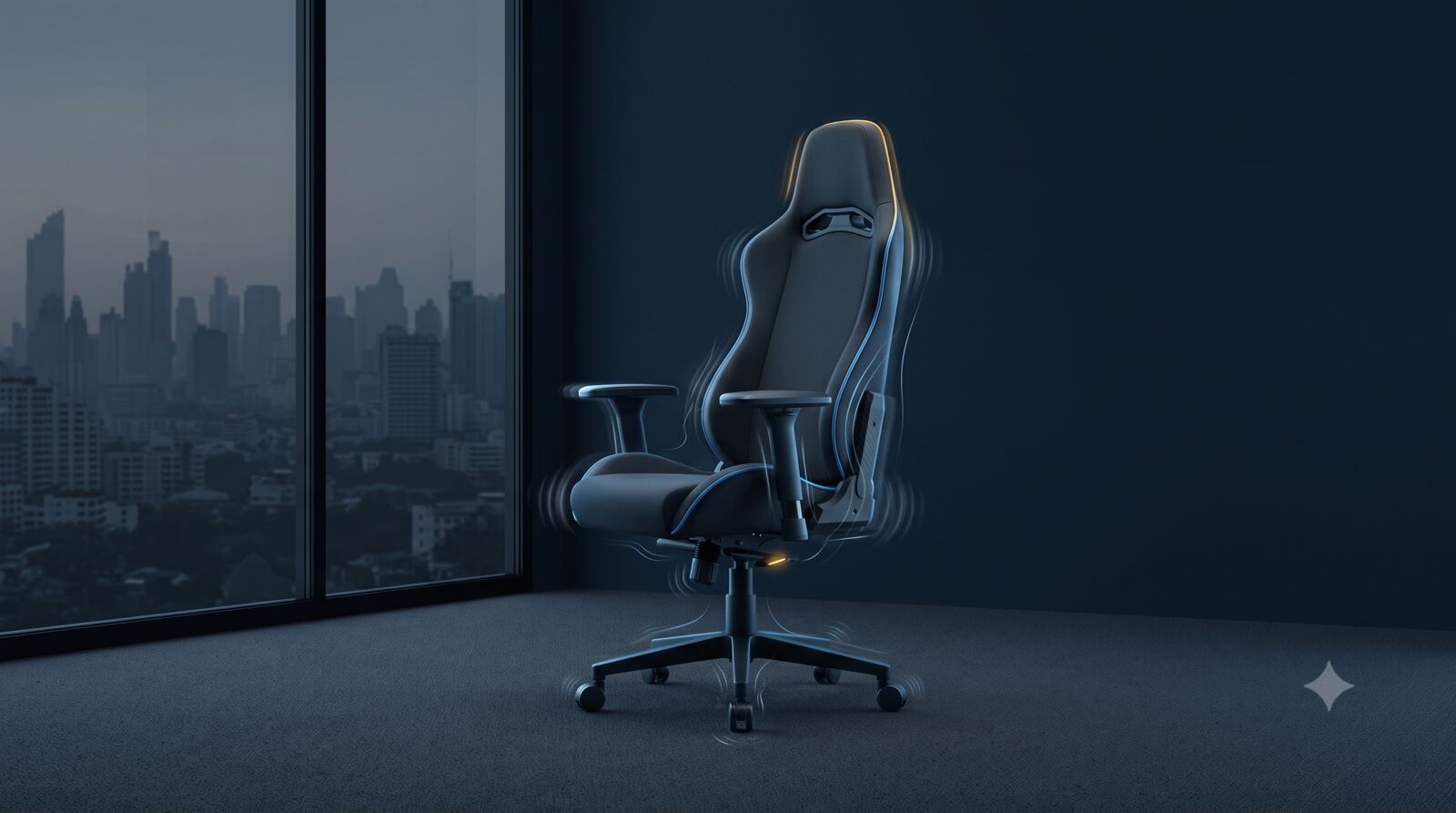
Shakes had spent about a year and a half developing what became the Cooler Master Motion 1, marketed as the world's first haptic gaming chair. Built around D-BOX's In-Line Haptic Engine, the chair translates in-game action into physical motion: drive a racing sim and the chair tilts through gear shifts and cornering forces; take a hit in an FPS and the chair delivers a jolt tuned to the moment. D-BOX, the company behind motion seating in cinemas and racing simulators, hand-coded more than 65,000 distinct haptic effects for the chair, according to the company's own product materials, and it shipped in an outwardly ordinary office-chair shell rather than looking like gaming hardware.
For Hakk, the chair wasn't just a client project. It was a case study in what he called the "compromise game" of turning a concept into something a factory can actually build. Shakes operates as a hybrid of designer and engineer under one roof specifically to manage that translation, coordinating with manufacturing partners in China while keeping creative direction in Bangkok. "It's not just because we as an agency work obviously in Thailand and then the manufacturing is, for example, in China," he said, "there's a lot of translation between what we want here and the factories that are doing the actual work."
That back-and-forth, he argued, is where most industrial design fails, not in the initial idea, but in the year of prototyping and re-prototyping required to get a physical object into the world at all.
One Bet Stumbled, the Other Is Quietly Compounding
Hakk made his prediction in September 2023, months after Apple had unveiled Vision Pro as the flagship example of exactly the kind of physical-digital immersion he was describing. Three years on, the two halves of that bet have diverged sharply.
Apple's headset has struggled. According to reporting from Hypebeast in January 2026, Vision Pro sold roughly 475,000 units through the end of 2025 for about $1.66 billion in hardware revenue, but Apple cut production in early 2025 and shipped only about 45,000 units in the 2025 holiday quarter, down from 390,000 in its 2024 launch year, while also slashing marketing spend by more than 95 percent. Reporting from AI Magicx and other industry trackers in early 2026 describes Apple pivoting toward a cheaper headset and AI-driven smart glasses, treating the current Vision Pro largely as a developer platform rather than a mass-market product. The broader spatial computing market is still growing (Treeview's 2026 industry statistics report puts it at roughly $158 billion in 2025, rising to about $202 billion in 2026) but that growth is concentrated in enterprise use and headsets from Meta, which industry estimates put at more than half of XR headset market share, not in the consumer immersion story Apple was selling.
Haptics, the quieter half of Hakk's bet, has fared better. Multiple market research firms tracking the sector in 2026 put the global haptic technology market somewhere between roughly $4 billion and $14 billion depending on methodology and scope, with one industry estimate citing 74 percent integration of haptic feedback into consumer electronics and 62 percent adoption in automotive interfaces worldwide. Growth is being driven by smartphone tactile upgrades, gaming peripherals, automotive driver-assistance systems, and the same XR hardware that's struggling on the headset side. Haptics is increasingly the layer that makes other immersive technology feel real, rather than a category competing against it directly.
Design business is best compromised in one word: chaos.
Read against that split, Hakk's underlying diagnosis holds up better than the specific bet he made. The industry didn't converge on face computers the way Apple's 2023 unveiling suggested it might. But the broader push to give digital experience physical weight, through touch, motion, and feedback rather than a headset strapped to your face, is exactly where the growth numbers point.
Why the Work Stayed in Bangkok
Hakk's studio takes on international clients, and he was candid about why those clients keep choosing Thailand over other manufacturing-adjacent hubs in the region, including China. Clients tolerate a slower pace of work, he said, because they'd rather be in Bangkok. That preference has since become a measurable pattern rather than an anecdote. Multinational manufacturers have spent the past several years actively diversifying production away from reliance on a single country, a strategy widely referred to as "China Plus One." Industry coverage in 2026 from supply chain analysts including Dimerco and Seasia Stats describes Southeast Asian countries, Thailand among them, becoming primary secondary-production destinations, with one estimate finding more than 73 percent of Fortune 500 industrial firms now running at least two parallel manufacturing footprints across markets like China, Vietnam, Thailand, and India. Thailand's Board of Investment has leaned into that shift, restructuring incentives in 2025 around electronics and smart manufacturing and reporting a 66 percent year-on-year jump in foreign direct investment value, reaching roughly 1.36 trillion baht, according to BOI data cited by regional investment advisories.
None of that policy shift existed in its current form when Hakk recorded the episode. But it validates the informal version of the same argument he was making from the client side: that Thailand's appeal isn't just cost, but a combination of ease of doing business, quality of life, and a design and craft culture he called a genuine asset for the country: "a good place to do design," in his words, feeding what he described as the country's broader creative spirit.
AI as a Faster Pencil, Not a Replacement
Hakk was less alarmist about artificial intelligence than much of the design industry has been. He described generative tools as useful mainly for compressing the early, unglamorous stages of a project: concept generation, communication, basic production tasks that used to eat hours. That framing has aged accurately. Adobe's own creator survey, published in October 2025, found 86 percent of a global sample of 16,000 creators now use generative AI in their work, with adoption among UX/UI designers specifically estimated near 48 percent, high enough to be normal, not high enough to suggest AI is doing the core creative judgment itself. Hakk's read was that AI works well as an accelerant for concept and communication, but hasn't touched the harder, slower problem his studio actually solves for clients: getting a physical object made correctly at all.
That distinction, AI compressing the idea stage while the manufacturing bottleneck stays stubbornly human, is where his 2023 assessment holds up best. Three years of subsequent AI hype haven't dissolved the "translation" problem between a design studio in Bangkok and a factory floor in China. If anything, it's made the studios that can manage that translation, chaos and all, more valuable, not less.