 Students Incorporated
Technology
Darrell Holst on the Junkyard That's Filling Earth's Orbit
ICS Bangkok teacher Darrell Holst explains orbital debris to students, and new ESA data show the junkyard above Earth is outgrowing every cleanup effort.
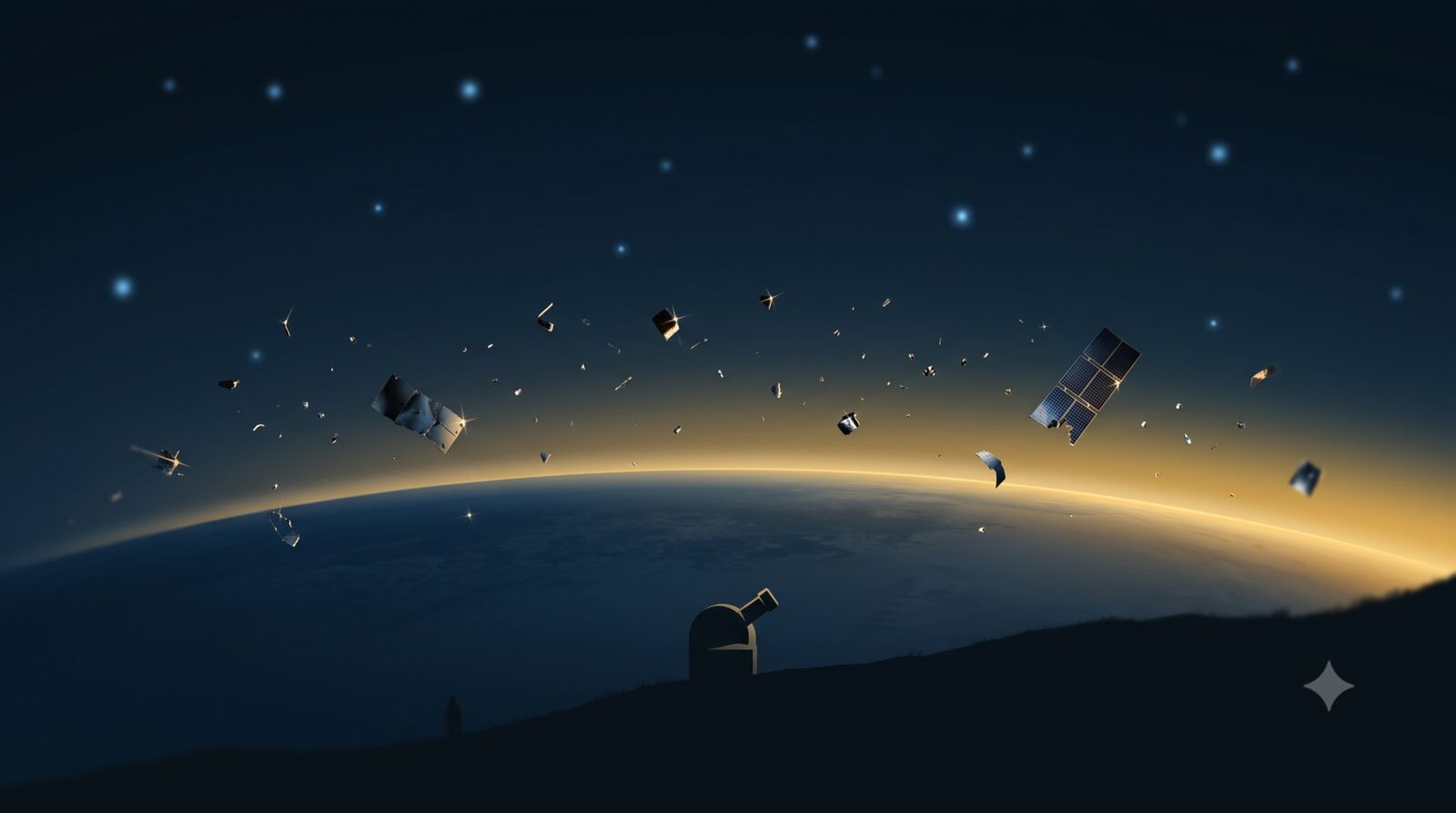
Earth's orbit has a junkyard problem, and it sits about 550 kilometers over our heads. For decades, a runaway chain reaction of orbital collisions was treated by space agencies as a distant hypothetical. It no longer is. The population of debris circling the planet is now large enough, and dense enough in the most valuable orbital bands, that the agencies tracking it say the fixes on the table won't catch up for years unless current habits change first.
That's the problem Darrell Holst, a high school science teacher at the International Community School (ICS) Bangkok who teaches the school's astronomy course, laid out for students in plain numbers on an episode of Students Incorporated, the school's student-produced podcast hosted by Mr. Jason with student co-host Yen Hao. Holst wasn't there only to talk about star formation and the scale of the cosmos, though he did plenty of that too. He was also there to explain why the empty-looking space just above the atmosphere is anything but empty.
What's Actually Up There
Holst told students that roughly 8,000 tons of debris are currently orbiting Earth: an estimated 130 million fragments smaller than a centimeter, about 34,000 pieces larger than 10 centimeters, and a NASA tracking effort that watches roughly 23,000 of the largest objects around the clock. None of it is decorative. A dead satellite or a spent rocket stage moving at orbital velocity can disable or destroy a working spacecraft on impact. "A newly launched satellite could be taken out by a piece of space debris that's in the wrong place at the wrong time," Holst said. Communications and GPS satellites could be knocked out, and crewed missions carry the highest stakes of all.
Those figures were accurate when the episode was recorded in early 2024. They've since been overtaken by newer counts, and not in a reassuring direction. The European Space Agency's Space Environment Report, published in 2025 using data through the end of 2024, put the number of objects actively tracked by surveillance networks at roughly 40,000, including about 11,000 active payloads. The population of untracked fragments larger than a centimeter, too small to follow individually but large enough to disable a satellite, is now estimated at more than 1.2 million. ESA's report also documented something new: within the most crowded low-Earth-orbit bands, the density of debris is now roughly the same order of magnitude as the density of working satellites. The neighborhood, in other words, is no longer mostly clear with the occasional hazard. It's genuinely crowded.
A Name for the Worst-Case Scenario
The scenario physicists worry about even has a name: Kessler syndrome, after NASA scientist Donald Kessler's 1978 prediction that once debris density in a given orbital band crosses a critical threshold, collisions start generating more debris faster than atmospheric drag and natural reentry can clear it out. That cascade, once triggered, could render entire altitude bands unusable for generations without a single new rocket ever launching again. ESA's 2025 report used almost exactly that framing, stating plainly that "even without any additional launches, the number of space debris would keep growing, because fragmentation events add new debris objects faster than debris can naturally re-enter the atmosphere," the mechanism behind Kessler syndrome. The agency logged several major fragmentation events in 2024 alone, adding thousands of new tracked objects in a single year, and concluded that the debris population saw net growth despite improved cleanup efforts.
Part of what's changed since Holst's episode aired is sheer traffic volume. Mega-constellations, the sprawling networks of small communications satellites operated by companies like SpaceX, barely existed at meaningful scale a decade ago. As of late July 2026, independent satellite-tracking services put the operational Starlink fleet at nearly 10,900 spacecraft, making it the single largest active constellation ever assembled and accounting for a majority of all operational satellites currently in space. SpaceX has stated an eventual goal of up to 42,000 satellites in the network. Every one of those spacecraft occupies the same crowded low-Earth-orbit bands that ESA flagged as increasingly debris-dense, and every one adds to the traffic that ground controllers already maneuver around thousands of times a year to avoid collisions.
The Cleanup Is Still Mostly a Plan
Holst told students in 2024 that engineers were developing nets and robotic capture systems to grab debris and steer it toward a burn-up reentry, pointing to a European Space Agency mission involving a robotic arm, then scheduled for 2025, as an example of active progress. That mission, ClearSpace-1, is a useful case study in just how hard debris removal turns out to be in practice. It was originally designed to capture a discarded rocket adapter, but in 2023 that very piece of debris was itself struck by a smaller, untracked fragment, generating new debris and forcing ESA to retarget the mission at a different defunct satellite instead. The mission has since been delayed and redesigned more than once, a reminder that even a single demonstration flight, built specifically to prove active debris removal works, has struggled to get off the ground faster than the problem it's meant to address gets worse.
Other efforts are further along on paper than in orbit. ESA has pushed a "Zero Debris Charter," now signed by 19 countries and more than 150 commercial and non-commercial organizations, committing signatories to a five-year limit for clearing satellites out of busy orbits after their missions end, tightening an older 25-year standard. ESA's own compliance data shows roughly 80 percent of its rocket bodies now meet that newer, stricter bar: real progress, but not enough to offset how fast new debris is being added. The agency has also started publishing a new "Health Index" meant to give a single, trackable signal for whether the orbital environment is trending toward sustainable or not. Its early verdict, based on current trends, isn't reassuring.
Wonder Doesn't Require a Clear Orbit
None of this made Holst's message to ICS Bangkok students a grim one. Most of the episode was spent on the opposite feeling: awe at scale most people never stop to consider. He walked students through how ancient civilizations tracked the sun, moon, and stars well enough to align structures like Stonehenge and the Mayan pyramids to the calendar year, explained how modern astronomers pull a star's composition, size, and motion out of nothing but its light spectrum, and described a 2022 James Webb Space Telescope image that showed unexpectedly large, well-developed galaxies in a part of the universe's early history where astronomers hadn't expected to find any. That finding, in his telling, is still pushing scientists to revise their models of how galaxies form.
That combination of real technical literacy paired with genuine wonder is what Holst tried to leave students with by the end of the segment. Asked what advice he'd give someone who isn't an astronomer but likes looking up and pondering, he didn't point them toward a telescope or an observatory trip.
Wonder can be found wherever you are.
Bangkok's light-polluted sky, he told them, still works as what he called a "beginner's version" of a dark night sky, good enough to learn the handful of visible planets and stars that can later serve as markers once you're somewhere darker. It's a fitting note to end on, because it cuts both ways. The same crowded sky that still rewards a five-minute look upward is also, less visibly, getting more crowded by the year with objects nobody can see from the ground. Whether the next generation of students gets a sky that's merely humbling to look at, rather than genuinely hazardous to operate in, depends less on any single mission than on whether the world treats orbital cleanup as urgent now, while it's still a five-year problem and not a fifty-year one.