 Students Incorporated
Education
Why Two ICS Bangkok Music Teachers Can't Focus With Music On
Two ICS Bangkok music teachers can't work with music playing. Brain science on musician attention and a 2023 lyrics study explain the paradox.
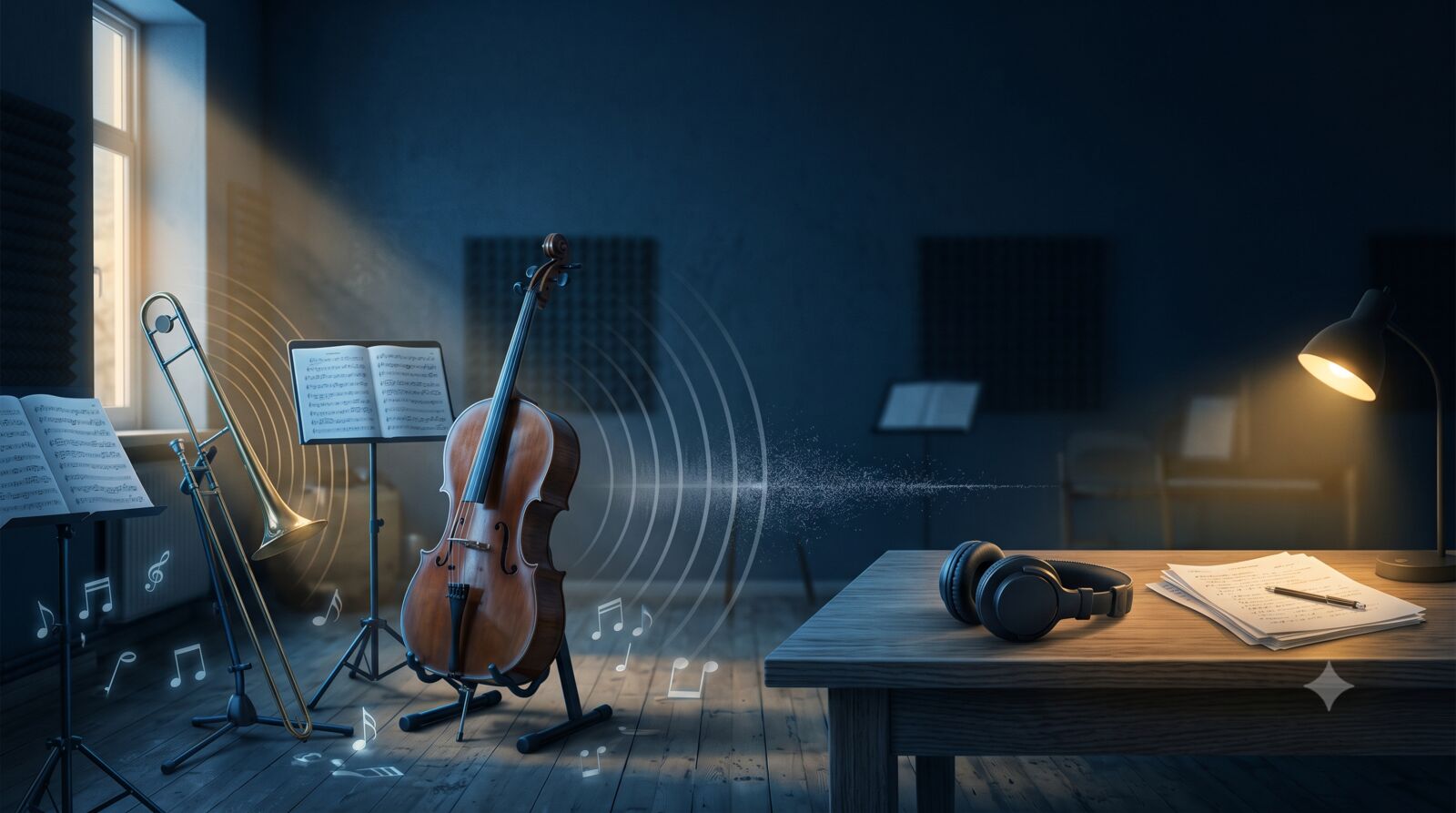
Christian Sarazin directs the band program at the International Community School (ICS) Bangkok. Sarah Nordblom teaches orchestra and AP Music Theory down the hall from him. Between them they've spent a combined two decades building their working lives around music, and when the two sat down on the school's student-produced podcast, Students Incorporated, they arrived at the same confession within minutes of each other: neither one can stand to have music playing while they actually work.
"It's very hard for me to have music on and do any sort of cognitive work at the same time," Sarazin said, describing what happens when he tries to grade papers or write lesson plans with anything playing in the background. He can manage it for genuinely mindless tasks, he'll put music on for washing dishes, but the moment the work requires thinking, he needs quiet. "Whenever I have to grade or study or write something, I got to have silence." Nordblom didn't hesitate to agree. "I can't listen to any actual music when I try to work, do any cognitive type of tasks," she said, adding that she prefers cafés with ambient chatter over silence, but never music, when she needs to concentrate.
It's a strange thing to hear from two people who chose music as a career. Sarazin picked up a trombone as a junior in high school after his grandfather, a former Army band musician, handed it down as a Christmas gift, and never put it down again; Nordblom grew up in a household of four siblings who all played orchestra instruments before training as a cellist. Music isn't background noise for either of them. It's the whole profession. And their shared aversion to working with it on isn't a coincidence: it's backed by actual neuroscience.
Why Trained Ears Can't Tune It Out
A study published in September 2025 by researchers at MIT's McGovern Institute for Brain Research offers a mechanism for exactly what Sarazin and Nordblom described. Neuroscientist Cassia Low Manting and colleagues used brain imaging to track what happens when people try to focus on one melody while a second plays at the same time, and found that people with musical training were consistently better at following their target tune, not because they tried harder, but because their brains had been rewired to do it. Musical training, the researchers found, sharpens neural circuits that amplify the sounds a listener wants to hear while suppressing everything else, a split between top-down attention (goal-directed focus) and bottom-up attention (the kind a fire alarm hijacks automatically). "The more musical someone is, the better they are at focusing their top-down selective attention, and the less the effect of bottom-up attention is," Manting told MIT News.
The catch is that the same wiring that lets a musician lock onto a single voice in an orchestra makes it harder to ignore music altogether. Manting, who plays piano and the Chinese harp, described the sound of her own instrument as being "like someone calling my name," impossible to tune out once it starts. For a band director and an orchestra teacher, whose vocabulary is built from sounds most people treat as background noise, the soundtrack that helps a non-musician push through paperwork is an active demand on the same attention their job runs on all day.
The One Genre That Gets Through
There was one exception in the conversation. Sarazin said the single genre he can actually work to is lo-fi hip hop, the loose, largely wordless instrumental music that has become the study soundtrack of choice for millions of students worldwide. "I've come to like lo-fi hip hop, like Studio Ghibli and things like that," he said. "But I can't have any sort of, especially classical music, because I just will listen to the classical music instead."
That instinct lines up with actual research on the genre. A 2023 study in the Journal of Cognition tested college students on verbal memory, visual memory, reading comprehension, and arithmetic under three conditions, silence, instrumental music, and music with lyrics, using lo-fi hip hop specifically as its instrumental condition. The result: lo-fi didn't measurably help or hurt performance on any task, while music with lyrics reliably hurt verbal memory, visual memory, and reading comprehension. The genre's whole appeal is that it's repetitive and low on surprise, built to sit in the background rather than pull focus, which is likely why "lofi hip hop radio: beats to relax/study to," the 24/7 stream once run under the name ChilledCow, became one of YouTube's strangest hits. Before the channel retired that particular stream in 2022, it had logged more than 668 million views across a nearly 21,000-hour continuous broadcast; the channel behind it, now called Lofi Girl, has since passed 2.5 billion total views and 15.7 million subscribers. Sarazin, without realizing it, had picked out the one strand of music actually built to survive contact with a trained ear.
What the Music Room Gives Back
The harder-to-quantify payoff showed up later in the same conversation, when the two teachers turned to what music actually does for their students. Nordblom described the yearlong logistics behind ICS's concerts: choosing repertoire months in advance, rotating percussionists so no one repeats a part all season, checking that every name is spelled correctly in the program the night before a show. Sarazin described similar season-long planning for band, then handed the question to a student sitting in the room. PK, a saxophone player, put it simply: "I feel like band is like a getaway for me... whenever I hop into the band room, I grab my saxophone and start playing, I feel like everything's off my shoulders."
That kind of testimony tracks with more systematic findings elsewhere. A 2023 study out of the University of Southern California's Thornton School of Music, led by music education researcher Beatriz Ilari and published in Frontiers in Psychology, surveyed students across Los Angeles public middle schools and found that music participation was tied to higher scores on measures of hope for the future and school connectedness, with the strongest effect among students who'd started before age eight. Ilari framed the findings against what she called a "nationwide mental health crisis" among adolescents, arguing that ensemble time gives students a structured outlet for identity and emotion at an age when both are unsettled, essentially the "getaway" PK described minutes earlier, without the academic language.
Nordblom, who grew up in Finland, noted that this kind of program isn't universal even where music education is taken seriously. "In Finland, we even don't have the similar types of programs at schools," she said of ICS's ensemble-and-concert structure, a reminder that the model built into American-style international schools (band class, orchestra class, seasonal concerts) is itself a specific design choice, not the only way to teach music to teenagers.
Choosing It Anyway
Near the end of the interview, the co-hosts asked both teachers the same question: what would your life look like without music? Nordblom answered first, describing stretches of her adult life when other commitments crowded music out, and how, every time she came back to teach a cello lesson or join an orchestra project, the people around her noticed the difference before she did. "Even my friends commented how those clearly were the things that made me the happiest," she said.
Sarazin took a moment longer, admitting he hadn't thought the question through as deeply as Nordblom had. But his answer, once he landed on it, doubled as the clearest statement of what draws someone into a career they can never fully switch off, even inside their own head.
"For me, it would be much less satisfying and colorful."
It's a strange kind of occupational hazard: spending a career building the very thing you have to escape from in order to think clearly. Listening to Sarazin and Nordblom describe it, though, neither sounded like they'd trade it.