 Students Incorporated
Education
Two ICS Bangkok Seniors Debated Policy Without Picking Sides
ICS Bangkok's student council president and VP debated the four-day school week and mandatory uniforms without knowing their assigned side beforehand.
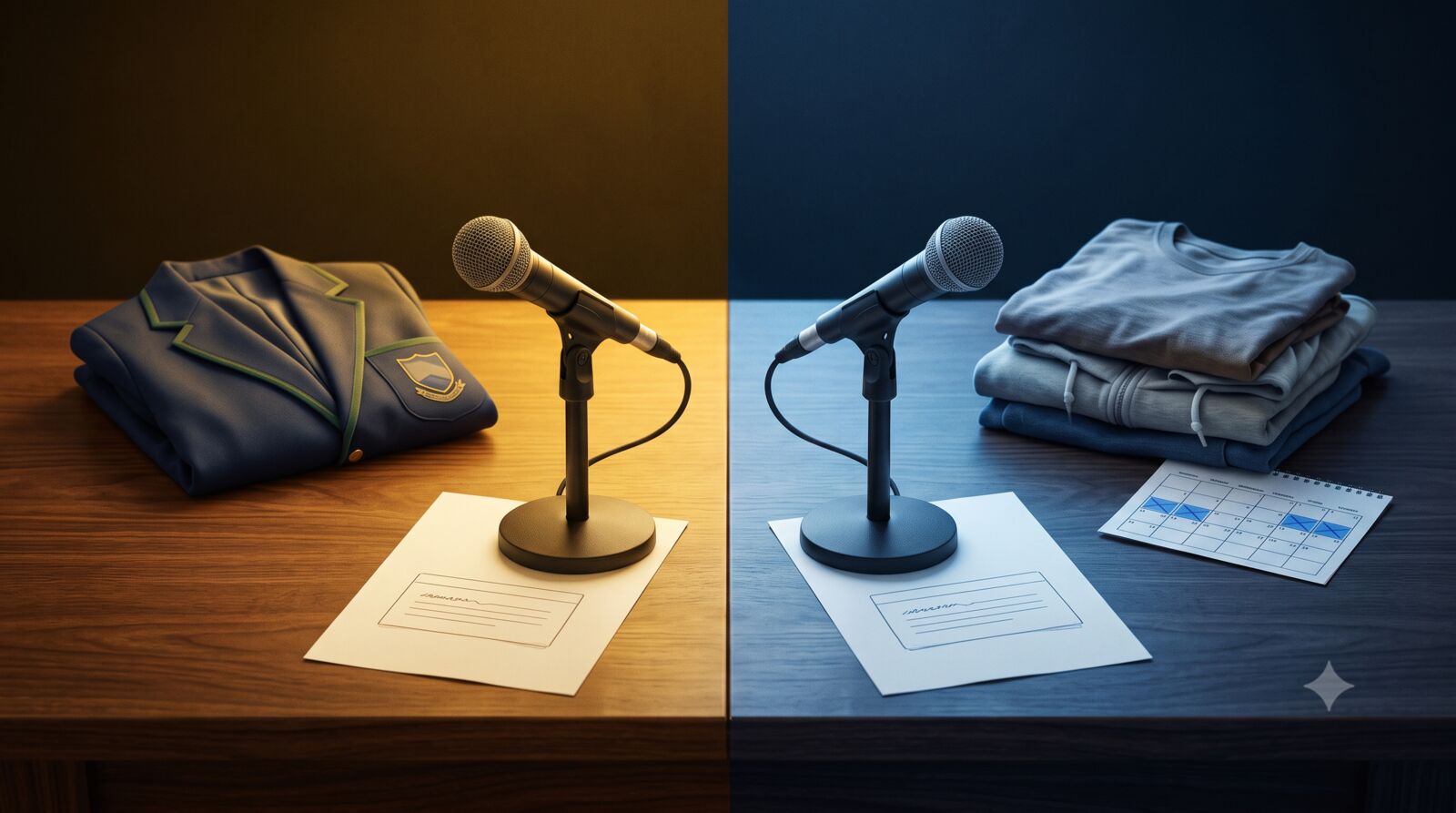
Two student council officers at the International Community School of Bangkok (ICS Bangkok) recently found themselves arguing school policy on television, or the podcast equivalent of it, without knowing which side they'd be defending until the microphones were already live. Xander, the council's president, and Gusty, its vice president, had been told the topics in advance: whether schools should move to a four-day week, and whether uniforms should be mandatory. What they didn't know was which position they'd have to build a case for.
It's a small structural choice with a real effect. On Students Incorporated, co-hosts Premi and Chania assigned sides on air, so neither debater could simply repeat an opinion they already held. Xander, arguing the side he was handed, made the case for a shorter week and against uniforms. Gusty argued the reverse on both. The result was less a rehearsed talking-points exchange than something closer to a real courtroom drill: it happened to land the two seniors squarely inside two of the more contested fights in American K-12 policy right now.
The Four-Day Week: "Rushed" Learning or Needed Rest
Assigned to argue for the four-day week, Xander leaned on recovery time: a shorter week, he said, "gives kids a lot of time to be able to rest and catch up on missing work," letting students move at their own pace instead of being "confined to the classroom." Gusty, arguing against it, countered that "the point of going to school is to learn, and if you go there for only four days a week, you're getting either a limited number of classes or those classes will have to be really rushed." He pushed further, invoking a bad personal experience with online precalculus to argue that compressed schedules (which often lean on remote coursework to make up lost time) remove the "accountability" a live teacher provides.
That exchange tracks closely with what researchers have found. The four-day school week has spread fastest through rural U.S. districts over the past decade, mostly to cut costs and ease staffing shortages, not as a pedagogical choice. But the evidence on learning outcomes is not kind to it. Researchers at the RAND Corporation have found that students in four-day districts lose the equivalent of two to seven weeks of learning per year compared with peers on a five-day schedule, and a 2025 review of eleven major studies found the losses concentrated in math and reading for K-8 students. RAND researchers warn that, left unchecked, the damage could eventually rival what the pandemic caused. The damage isn't uniform, though: districts that run fewer than 30 instructional hours a week drive most of the negative effect, while those that hold onto 32 hours or more (typically by lengthening the remaining four days) show no statistically significant achievement gap at all.
There is a case for the other side beyond academics, too. A study of Oklahoma high schools found the four-day week appeared to reduce bullying, fighting, and bus incidents: evidence that the calendar shift can pay off in campus climate even where it doesn't help test scores. That's roughly the argument the ICS Bangkok debate never quite reached, since the format kept both students anchored to learning outcomes rather than school culture. Still, the fact that a Bangkok classroom exercise landed on the same fault line (rest and flexibility versus instructional time and rushed content) as districts from Missouri to Colorado is a reminder that the underlying tradeoff isn't really about geography. It's about what a school day is for.
Uniforms and the Argument Nobody Expected
The second round flipped the more familiar script. Gusty, defending uniforms, argued they build unity in a diverse student body and give everyone "something that they can agree on." Xander, arguing against, made the case for self-expression, but then pivoted to something less predictable: cost. Uniforms, he argued, hurt "families who are financially distressed" because ICS-branded shirts and pants "can often be very costly," while opting out would let lower-income families choose cheaper clothing instead.
That's a reversal of the argument uniforms usually win on. In the U.S., uniform mandates are frequently sold as an equalizer for lower-income students: a way to mask what a family can and can't afford. But the research doesn't fully back that framing. Uniform policies show up in 47% of high-poverty U.S. schools versus just 6% of low-poverty schools, per a 2019 study in Compare: A Journal of Comparative and International Education, meaning the policy is concentrated in the schools serving the students it's meant to protect. The same research found the intended leveling effect erodes quickly in practice: wealthier families can afford several sets of uniforms that stay crisp, while lower-income students often make do with one or two sets that visibly wear out, highlighting economic gaps rather than hiding them. Broader outcome data is similarly unconvincing: national studies using representative samples have found uniforms carry no significant effect on attendance, behavior, or most academic measures, even though individual schools often report improvements in discipline right after adopting one.
Xander's real-world instinct (that uniforms can quietly become a tax on families with less to spend) lines up with what that research actually shows, even if the podcast debate never got as far as citing a study. Gusty's rebuttal, that a shared uniform still functions as a practical, if imperfect, unifier, is echoed in narrower contexts: researchers studying school-sports uniform policies have found that simple, standardized kits can benefit students with sensory sensitivities and reduce the visible cues kids use to sort each other by wealth. The honest answer, in other words, sits closer to "it depends what you're optimizing for" than either side let on, which is arguably what a good debate is supposed to expose.
"We have the student council, and not the student outfits council."
Practicing a Skill That's Reportedly Disappearing
The format itself is worth pausing on. Assigning debaters a position they don't choose is a staple of competitive policy debate and mock trial, designed to keep a student from just restating a pre-formed opinion. It forces the harder work: understanding an argument well enough to make it, whether or not you believe it.
That kind of structured disagreement is getting harder to find outside the debate room. Surveys of Gen Z's political habits paint a mixed picture. A survey from Johns Hopkins University's SNF Agora Institute found younger respondents more likely than older generations to say they'd had conversations across political differences or made an effort to understand an opposing view, and less likely to describe people on the other side as "evil" or "less than human." At the same time, GIS Reports, a geopolitical analysis outlet, reported this year that Gen Z shows heightened political alienation and is more willing to view intimidation or disruptive protest as legitimate political tools, a pattern researchers tie partly to a generation getting most of its political information from social feeds rather than venues built for back-and-forth argument. A 2025 Ipsos poll found political extremism was the single issue Americans named most often as the country's biggest problem.
Against that backdrop, an exercise like the one Xander and Gusty went through (arguing a position you didn't choose, in front of an audience, without knowing in advance which side you'd land on) reads as more than classroom filler. It's a rehearsal for exactly the skill polling suggests is thinning out: taking an opposing argument seriously enough to make it well. Xander and Gusty run a council that already spends its year negotiating tight internal deadlines, a banquet it runs at a financial loss on purpose, and logistics across three divisions of the same school. Trading debate positions blind, for ten minutes on a podcast, turned out to be good training for the rest of the job.