 Students Incorporated
Careers
The ICS Teacher Who Watched Forensic Science Get Invented
ICS Bangkok's Mrs. Debbie earned one of forensic chemistry's first degrees in 1996, tracing true crime's rise into one of science's fastest-growing careers.
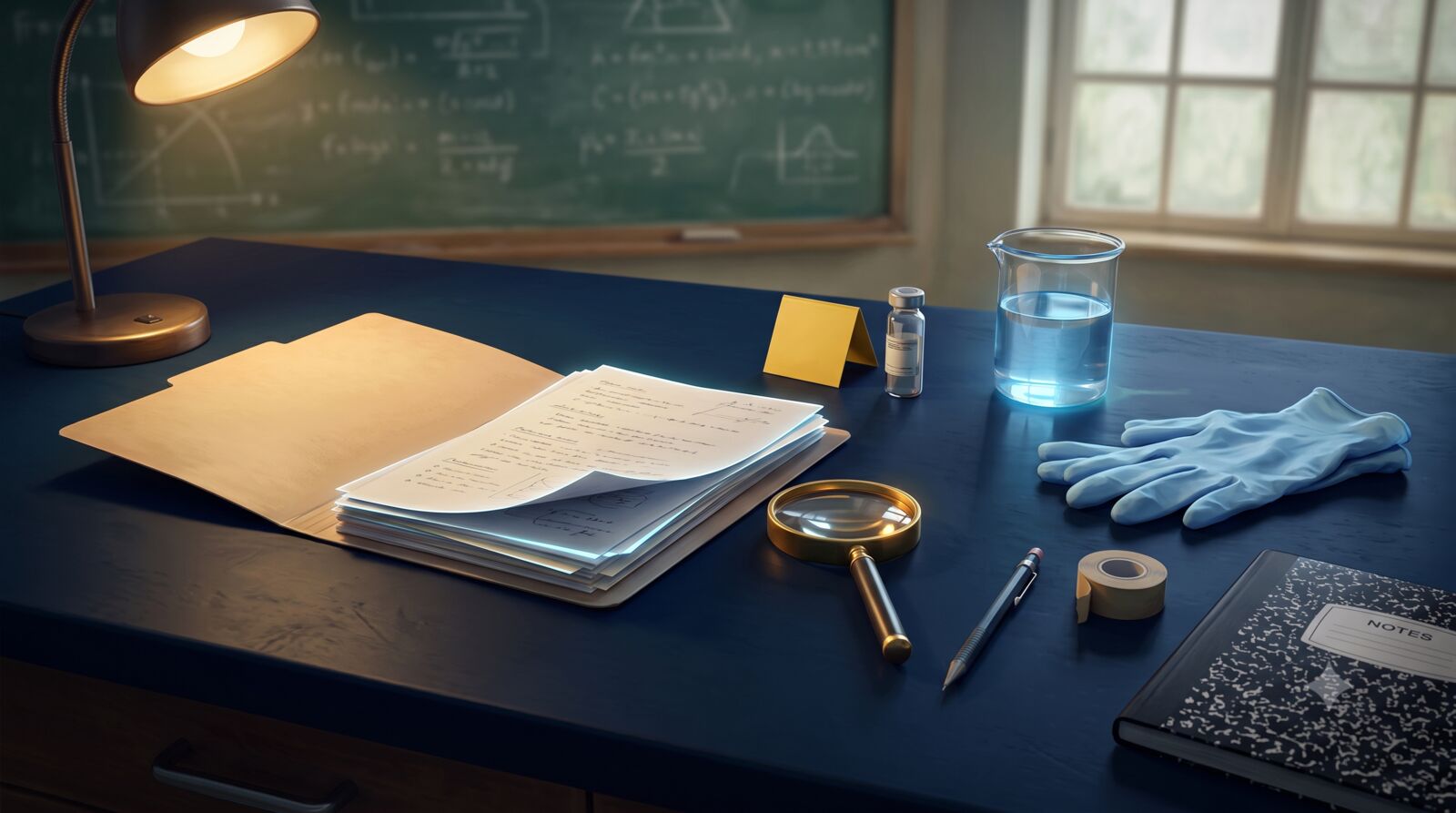
In 1996, forensic science wasn't a major with a shelf of textbooks behind it. It was a brand-new degree program, built out of a chemistry department at a University of Texas campus in Fort Worth, and it existed before CSI put the word "forensics" into households worldwide. Mrs. Debbie, who now teaches forensic science, chemistry, and AP environmental science at the International Community School (ICS) Bangkok, was one of the first people to walk through that program. She was 46 when she went back to college and, by her own account, didn't know how to spell "chemistry" when she started. Nearly three decades later, her class is built around the discipline she helped pioneer, and on a recent episode of the school's student-produced podcast, Students Incorporated, she laid out how much has changed since a curiosity about crime turned into a career.
A Question That Started With a Tragedy
Mrs. Debbie traces her interest in forensics back further than her college years. In high school, a friend was killed in an accidental shooting, leaving her with a lasting question about what pushes people toward violence. "I think I've always had that interest in it," she told student co-hosts Lyon and Linda, describing a curiosity about "what drives somebody over an edge to commit a murder or hurt somebody." That question sat unanswered until she was 46, when she went back to college and found herself steered toward chemistry rather than the vague curiosity she'd carried for years.
The forensic science track she landed in was one of the first of its kind, and the timing meant her instructors weren't career academics. They were working professionals: forensic anthropologists, forensic toxicologists, and staff from the local coroner's office, brought in because the field was too new to have its own faculty yet. That arrangement gave her direct access to real casework most students never see, including autopsies. She recalled one gunshot autopsy abruptly canceled mid-session when staff realized the deceased was related to a student in the observing class, and noted that several of her former colleagues had worked on evidence connected to the 1993 siege in Waco, Texas. "Not everybody can do physics," she said of why she pushes the subject so hard with her own students now, "but everybody can do forensics."
Teaching Across Two Continents
After finishing her degree, Mrs. Debbie spent years teaching in Hong Kong before relocating to Bangkok, describing the adjustment less as a career pivot and more as a shift in vantage point. "It's really neat to realize that you get to look at America in a different viewpoint when you're out of it," she said. At ICS Bangkok, forensics has become the class she says fits her teaching style best: hands-on, case-based, graded like real casework rather than tested like a lecture course. It's also, by her account, the class students choose over ones they're required to take.
That popularity isn't unique to her classroom. The genre she's teaching around has become one of the biggest stories in American media over the past decade. True crime now reaches roughly 42 million Americans monthly, according to Edison Research, making it one of the five most popular podcast genres and the single most popular one among women. A 2023 Pew Research Center analysis found true crime podcasts skew especially popular among listeners without a four-year college degree, cutting against the assumption that the genre is a niche interest. The growth hasn't leveled off, either: Sounds Profitable and Variety both reported true crime listening hours on Spotify climbed roughly 50% year over year in 2025, driven partly by video formats that let creators share field footage and case documents alongside the audio.
The Real Story Behind the Interview Room
The most striking material in Mrs. Debbie's segment concerns criminal profiling, a discipline she connects to a book she calls Mind Hunters about an FBI agent who pushed the bureau to start systematically interviewing convicted killers. She didn't name him, but the agent she's describing is almost certainly John Douglas, the FBI's pioneering criminal profiler, whose 1995 book Mindhunter: Inside the FBI's Elite Serial Crime Unit became the basis for the Netflix series of the same name. According to reporting from A&E and the profile outlet All That's Interesting, Douglas spent 25 years building the bureau's Behavioral Science Unit and personally interviewed serial killers including Edmund Kemper, John Wayne Gacy, Ted Bundy, and Charles Manson; by 1979, he and fellow agent Robert Ressler had already logged interviews with 36 convicted murderers. The bureau initially resisted the project before Douglas's early interviews proved the approach could help solve cases.
Mrs. Debbie's account of watching classroom recordings of those interviews matches how Douglas has described the sessions himself: eerily calm, almost administrative. "There's no emotion there," she said, describing an interview with Gacy. "They'll sit down and have tea and they just talk like it's not a big deal." That flatness, she explained, is part of what makes profiling possible: investigators look for a killer's modus operandi, the consistent signature in how a crime is committed, precisely because these are not, in her words, "dumb people." They tend to have above-average intelligence, part of why they evade capture as long as they do.
Technology Cuts Both Ways
Pressed on how technology has changed crime and its detection, Mrs. Debbie called it "a two-edged sword." On one side, she pointed to facial recognition as a genuine forensic breakthrough. On the other, she raised China's surveillance capacity: "China claims they can find you in 10 minutes now," she said, "because they have so many CCTVs out there." Her number was close, if not exact. A widely reported 2017 BBC test had a reporter attempt to evade detection in Guiyang, a Chinese city of roughly 3.5 million people; local police, cross-referencing footage against a database of residents, located him in seven minutes, according to TechCrunch's coverage at the time. China's surveillance network has only expanded since, with industry estimates putting the country's camera count in the hundreds of millions.
Mrs. Debbie was careful to note that the same always-recording internet that enables that kind of detection also has a darker side, pointing to trafficking and exploitation that flourish on parts of the internet law enforcement struggles to reach, aided by VPNs that mask bad actors' locations. It's a tension she returns to with her students often: every tool that helps investigators build a case can just as easily help someone avoid one.
A Field That Keeps Growing
Mrs. Debbie's advice to students weighing a similar path is blunt: don't assume a prestigious university is automatically strong in forensics, and figure out which corner of the field interests you before choosing a program, whether that's toxicology, crime scene investigation, forensic psychology, or federal law enforcement. That last category, she noted, spans agencies from the FBI and DEA to Interpol.
Her instinct that the field keeps expanding checks out. The U.S. Bureau of Labor Statistics projects 13% employment growth for forensic science technicians between 2024 and 2034, more than four times the 3% average projected across all occupations, driven largely by state and local governments processing rising caseloads and by scientific advances making forensic evidence more reliable in court. The bureau counted about 20,700 people working as forensic science technicians in 2024, with a median salary of $67,440. None of that existed as a defined career track when Mrs. Debbie enrolled in a brand-new program at 46, uncertain how to spell the subject she was about to spend the rest of her working life teaching. What started as a personal question about why people commit violence has become, in the years since, a mainstream career path and a genre that dominates podcast charts, proof that the curiosity she brought into a Texas classroom in 1996 was never as niche as it looked.
Not everybody can do physics, but everybody can do forensics.