 Students Incorporated
Community
The Holiday Mosaic Inside a Bangkok International School
A holiday episode of Students Incorporated shows how Christmas gets reinvented at a Christian school in a country that is over 90% Buddhist.
Thailand is a country where, by the government's own count, roughly 93 percent of the population is Buddhist and just over 1 percent is Christian. Walk into the International Community School of Bangkok during the second week of December, though, and you'd think the whole country ran on Advent calendars and eggnog. That contradiction is the real subject of a special holiday episode of Students Incorporated, in which more than a dozen teachers and students, none of them from the same country, laid out how they personally build a holiday that their home country may not even officially celebrate.
The answer, episode after guest, was: not the same way twice.
A Holiday Assembled From Borrowed Pieces
Host Mr. Jason and co-hosts Frank and Mia spent the bulk of the episode running the same two questions past teachers, staff, and students: where is your family from, and what do you actually do during the holidays? The pattern that emerged wasn't one culture absorbing another. It was a dozen separate traditions running in parallel inside the same building.
Grade 7 science teacher Stephen Conwell, who is Australian and married to a Canadian, described a household that celebrates a version of Christmas that isn't really Australian at all: a nightly reading of The Best Christmas Pageant Ever by his wife's mother, an annual family viewing of the film White Christmas, his father-in-law loosening up over champagne while reciting every line from memory. Qing Yu, a secondary mentoring teacher originally from Taiwan and now a dual U.S. citizen, described 20 years of Pennsylvania winters spent on potlucks and barbecues with friends, sometimes broken up by a trip to a warmer state. High school math teacher Vicki traced her family's Christmas Eve pajama tradition back to her mother's original, more practical motive: guaranteeing everyone looked presentable in the next morning's photos. It's a tradition, she said, "that keeps on giving once you become the parent," with eight new pairs to buy every year, without fail.
Some of the sharpest detail came from guests translating a holiday that isn't native to their culture at all. Kru Yam, a Thai teacher of 20 years, described how her father became the only Christian man in his village, eventually converting his own house into a church; her family now travels to that village every Christmas to preach, sing, and bring gifts to residents, treating the holiday less as a gift exchange and more as an annual homecoming built around service. Filipino staff member Mr. Micah described Noche Buena, a Christmas Eve tradition of staying up until midnight to exchange gifts rather than waking up to them, alongside Filipino desserts he admitted he couldn't fully name. Eva, a Russian senior, explained that her family doesn't celebrate Christmas on December 25th at all: Soviet-era suppression of religion pushed the holiday's trappings onto New Year's instead, a shift so complete that gift-giving, tree-decorating, and the countdown to midnight now happen a week early, with the 6th or 7th of January reserved for those who still mark Christmas itself. A Dutch student named Elise described celebrating Sinterklaas on December 5th before her family moved to Thailand and adopted a Christmas Eve church service on top of it. A South Korean junior, Eunwoo, described spending the holiday at a family missionary camp.
Then there was Adi, a senior with an Indian passport, who best captured what makes this community unusual: his family is Buddhist, but because they attend a Christian school, they spend every Christmas volunteering at a Thai-run church, serving food, donating supplies, singing along even when, by his own admission, his voice doesn't quite hold up. "Coming from a Christian school and a Christian environment," he said, "the holiday season for me usually correlates with the idea of giving more than receiving."
That line applies to the school as an institution, too. ICS Bangkok is one participant in what's become a genuinely large industry: Thailand's international school sector grew to 249 schools enrolling 77,734 students in 2024, a 10 percent jump from the year before, according to data reported by Khaosod English, with the business now valued above 85 billion baht, up from roughly 100 schools nationwide in 2014. Bangkok alone accounts for more than 100 of those campuses, meaning the cross-cultural holiday improvisation happening in this one episode is playing out, in some form, across dozens of similar campuses citywide, serving families for whom Christmas is foreign, borrowed, reinvented, or some mix of the three. Elsewhere in Buddhist-majority Southeast Asia, the pattern holds: Christmas functions as a largely secular, commercial season grafted onto countries where it isn't the default religious calendar, showing up in malls and hotel lobbies well before it shows up in church attendance.
When the Giving Season Becomes a Business Plan
The episode's second half shifted from personal tradition to corporate strategy, just as revealing. Tetra Sakthi Redpanupan, executive director at Mania Group, described two Bangkok holiday initiatives that treat "giving back" as something closer to a design brief than a donation drive.
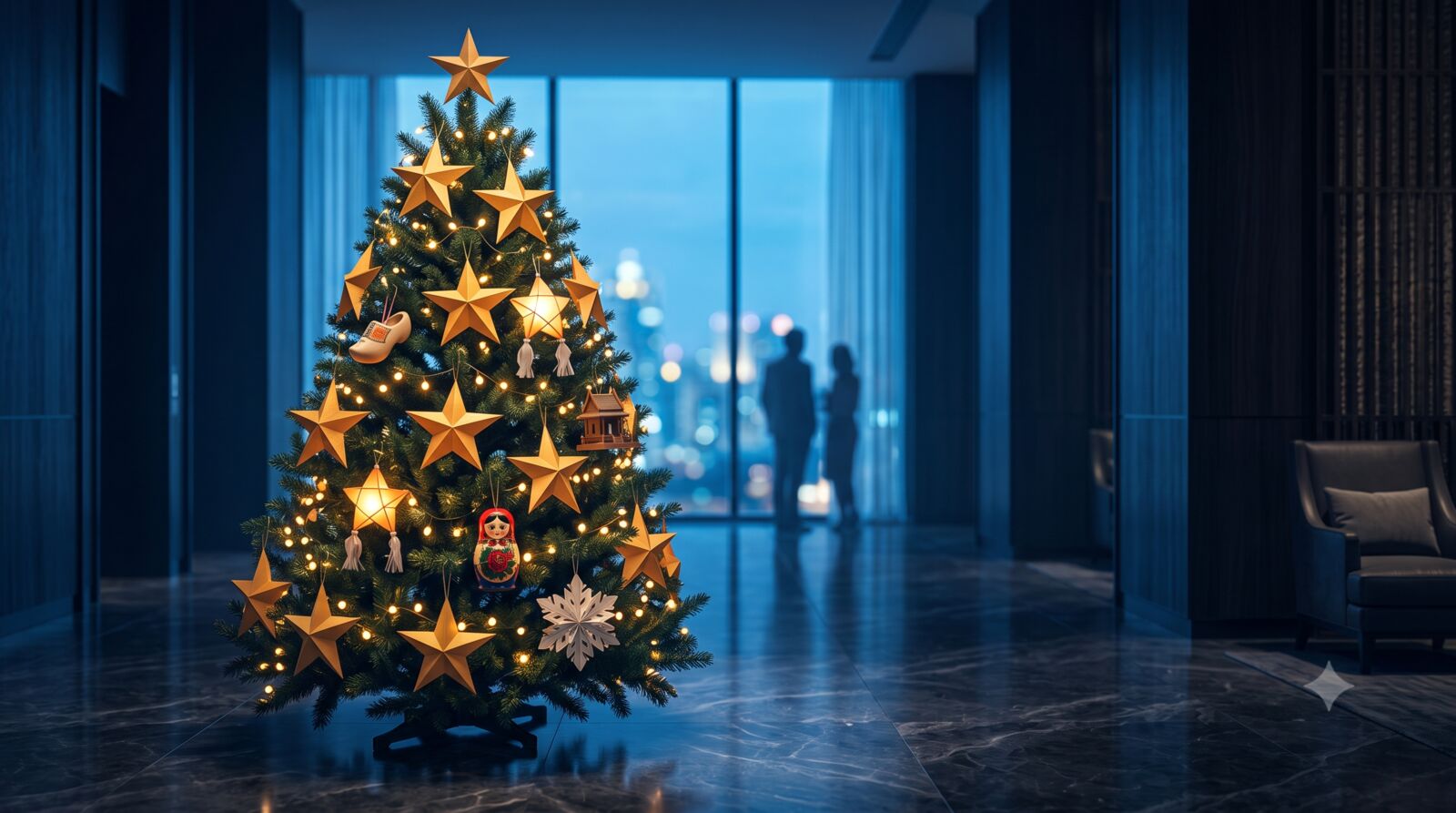
The first, called Wish Upon a Star, runs through a Renaissance hotel property in Bangkok: guests browse a lobby Christmas tree hung with paper stars, each representing a specific wish from one of 40 children connected to the Foundation for Slum Child Care. Visitors either buy the gift themselves or pay the hotel a flat fee to source it on their behalf, with the presents delivered to the children before the holiday. The Foundation for Slum Child Care is a real, decades-old charity: established in 1981 by Prateep Ungsongtham Hata, who won the Ramon Magsaysay Award in 1978 for founding a school in one of Bangkok's slum communities and later used prize money from a second award to start the foundation, which today runs daycare programs for thousands of children. The specificity of the guest's description, a wish tied to one named child, fulfilled by one guest, fits an organization built around individual sponsorship.
The second initiative, Mania Market, is less about charity and more about access. Redpanupan described it as the company's first general pop-up market, giving free booth space to small Thai businesses that otherwise only sell online, plus stage time for local buskers. "I feel like at the end of the year, everyone deserves a chance to be given any sort of opportunity to be happy," she said, framing the market less as a marketing stunt than as a redistribution of foot traffic her company already owns. The timing tracks with a real shift in Thai retail: the country's e-commerce market crossed 1 trillion baht in 2024, and government-backed campaigns like "Thai Chuay Thai" have specifically targeted the gap between online-only small sellers and the physical foot traffic that malls, hotels, and office towers can offer for free. It's not a novel idea, but it's a live one in Bangkok's small business economy right now, not just a nice line for a podcast interview.
What the Season Is Actually For
The episode closed with Mr. Steven Lattice, delivering a message that, stripped of its specific Christian framing, doubled as a summary of everything the previous forty minutes had shown from a dozen different angles: a Chinese Taiwanese-passport senior who barely marks the day, a Russian senior who celebrates it a week early, a Thai teacher whose father built a village's only church, and a hotel executive turning a lobby Christmas tree into a direct line to children in one of the city's poorer neighborhoods, all converging on some version of the same instinct.
In the end, generosity often involves sacrifice.
None of these traditions look alike. None of them had to. That's the more interesting story: a Bangkok school where the holiday season isn't imported wholesale from one culture, but rebuilt, every December, out of whatever pieces two dozen families happen to be carrying.