 Students Incorporated
Storytelling
The Class Divide Still Hidden Inside 'Merry Christmas'
A Bangkok student podcast's holiday etymology segment traces 'Merry Christmas' to a prisoner's 1534 letter, Dickens, and a snobbery still alive at the Palace.
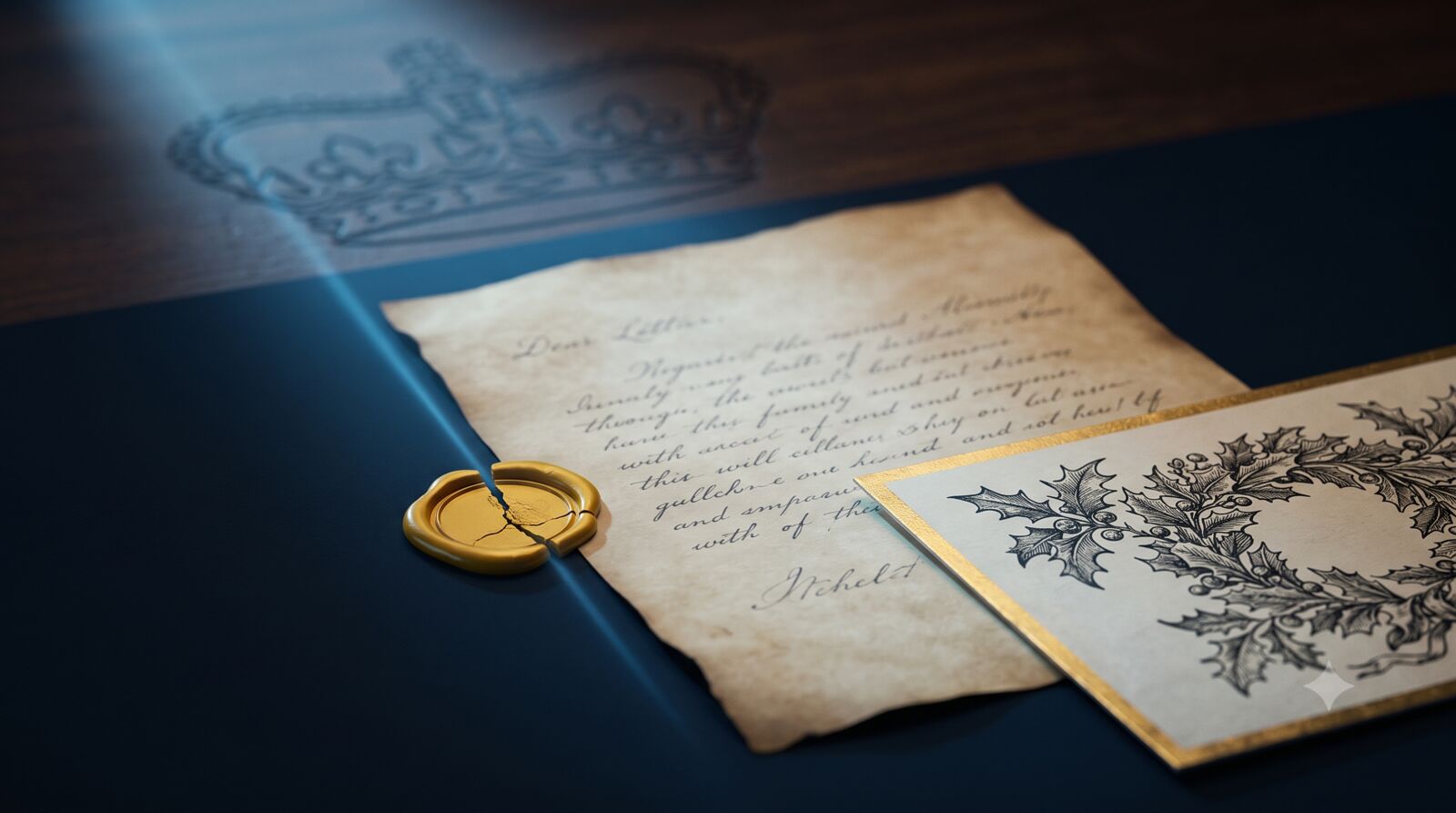
"Merry Christmas" and "Happy Christmas" sound interchangeable, but the choice between them has tracked a class line in English for nearly two hundred years, a divide a group of Bangkok high schoolers walked straight into during a holiday special. On a Season 2 episode of Students Incorporated, the student-produced podcast out of the International Community School (ICS) Bangkok, the crew paused their Christmas-cheer programming to ask a genuinely good question: why do English speakers say "Merry Christmas" and nothing else "merry"? Nobody wishes anyone a Merry Birthday or a Merry New Year. Their answer, assembled live on air by five students and host Mr. Jason, brushed up against one of the more persistent snobberies in the English-speaking world without quite naming it.
A Phrase First Written From a Prison Cell
Premi, the student who opened the segment, had done real homework. She dated the earliest known appearance of "Merry Christmas" to a December 22, 1534 letter from Bishop John Fisher to Thomas Cromwell. Surviving copies of that letter, catalogued by historians of the English Reformation, show it closing with the wish that "our Lord God send you a mery Christmas, and a comfortable, to your heart's desire." Premi didn't get into the circumstance Fisher wrote it under. Records of Fisher's life show he had been a prisoner in the Tower of London for eight months at that point, jailed for refusing to recognize Henry VIII as supreme head of the Church of England. He would be beheaded on Tower Hill the following June. The first recorded "merry Christmas" in the English language, in other words, was written by a condemned man to the very official prosecuting his case.
Premi also flagged the phrase's second life, more than three centuries later. Charles Dickens published A Christmas Carol in 1843, and the greeting appears in it 21 times, leading scholars of the book's cultural impact to credit it with reviving a phrase that had largely fallen out of use. That same year, the London civil servant Sir Henry Cole commissioned what's widely regarded as the first commercial Christmas card, illustrated by the artist John Callcott Horsley, printed with the line "A Merry Christmas and a Happy New Year to You." Smithsonian Magazine's history of the Christmas card credits these two coincidental 1843 releases with cementing "merry" as the default.
Merry has much more of a cheerful and joyous meaning that isn't attached to things or objects necessarily.
The Word Had Enemies Long Before the Palace
The royal family wasn't the first English-speaking authority to flinch at the word "merry." More than two centuries before any Windsor worried about it, Puritan lawmakers in the Massachusetts Bay Colony banned Christmas outright. A 1659 statute known as the "Penalty for Keeping Christmas" fined anyone five shillings, worth roughly $50 today, for marking the day by skipping work, feasting, or celebrating "any other way." Massachusetts didn't repeal the ban until 1681. Historians who've studied the law trace the objection to the same instinct that would later worry the Victorians: to the Puritans, Christmas wasn't a solemn religious observance so much as an occasion for the kind of loud, drunken, pagan-flavored revelry that "merry" was built to describe. The word survived the ban, but the suspicion attached to it didn't disappear. It just crossed the Atlantic back to England and resurfaced, dressed up in more polite language, two hundred years later.
Why the Palace Kept Saying "Happy"
The etymology segment wasn't the only place this episode brushed against royal Christmas history. Earlier in the same show, in a rundown of "historical holiday news," the crew covered Queen Elizabeth II's first televised Christmas message, broadcast on December 25, 1952, continuing a tradition her grandfather King George V had started by radio two decades earlier, in 1932. The podcast didn't connect the two segments, but the wording the royal family actually reached for, decade after decade, undercuts the very word their own show was busy defending.
The late queen said "Happy Christmas," not "Merry," and so, by most accounts, did generations of her family before her. The reason traces to nineteenth-century class anxiety: as the etymology outlet Grammarphobia and the local-history desk at Surrey Live have both documented, some Anglican clergy and upper-class Victorians came to treat "merry" as a word for noisy, boisterous, drink-adjacent celebration, the kind of Christmas working people had in pubs, while "happy" signaled a quieter, more spiritually serious kind of joy. The royal family's preference for "happy" over the centuries wasn't neutral vocabulary. It was, by most accounts, an attempt to keep a polite distance from a word that had gotten too downmarket for a monarch to use on television.
That distance never fully closed the loop back into ordinary British speech. Public opinion, when it's actually been measured, doesn't side with the Palace. A YouGov survey conducted in December 2020 found that 78% of Britons said they preferred "Merry Christmas" as a greeting, compared with just 5% who favored the neutral "Season's Greetings," and a further 11% who said they weren't keen on either option. "Happy Christmas" barely registers as most people's stated preference at all anymore, royal habit notwithstanding. Whatever the Victorians thought "merry" said about a person's manners, it won the argument in the country that invented the objection.
What the Students Landed On Without the History
None of this class history made it into the podcast's own conversation, but the crew arrived at something like the right instinct anyway, just from the opposite direction. Asked what "merry" means to her, Chanyeol offered the dictionary version: "to be full of cheerfulness and to have a joyous disposition," adding that it also carries a sense of being "laughingly happy" and festive. Patience called it "jolly" and "high-spirited." Rebecca tied it to gratitude as much as celebration. Yen Hao argued "merry" captures "a spirit of warmth and giving" precisely because the word is so tightly bound to Christmas that saying it conjures the holiday itself, gift-giving and all.
It was Mr. Jason, closing out the round, who made the class distinction the Victorians actually cared about, only in reverse. "Happy is such a common word," he said. "We hear it all the time and we use it all the time. And it has somewhat lost its impact and meaning. We assign everything to happy, where merry has much more of a cheerful and joyous meaning that isn't attached to things or objects necessarily." In his telling, "happy" is the word that's been cheapened by overuse, while "merry" is the one still doing real work, reserved for an actual event instead of a generic emotional state. Nineteenth-century Anglican clergy would have found this exactly backwards: to them, "happy" was the elevated, careful word and "merry" was the one too loose for polite company. Two centuries and one very informal etymology roundtable later, popular usage and a group of Bangkok teenagers have both quietly overruled that judgment. The rowdy word won.
The segment ran for roughly ten minutes inside a much longer holiday broadcast that also had all three of the school's principals assigning each other elf names, a trio of elementary schoolers rating their favorite Christmas songs, and the headmaster recalling the North Face jacket he'd begged his parents for as a teenager. It wasn't built to be a linguistics lecture. But the question the crew asked out loud, why does only one holiday get the "merry" treatment, turns out to have a real answer, one that runs through a prisoner awaiting execution, a beloved Victorian ghost story, a hand-illustrated Christmas card, and a monarchy that spent a century trying to sound more refined than its own subjects. Language doesn't usually keep a scoreboard this legible. This one happens to.