 Students Incorporated
Education
The 15-Baht Packet That Still Beats a Cholera Epidemic
A cheap mix of sugar and salt cuts cholera deaths from 50% to under 1%. An ICS Bangkok teacher explains why that fact still matters as outbreaks rise.
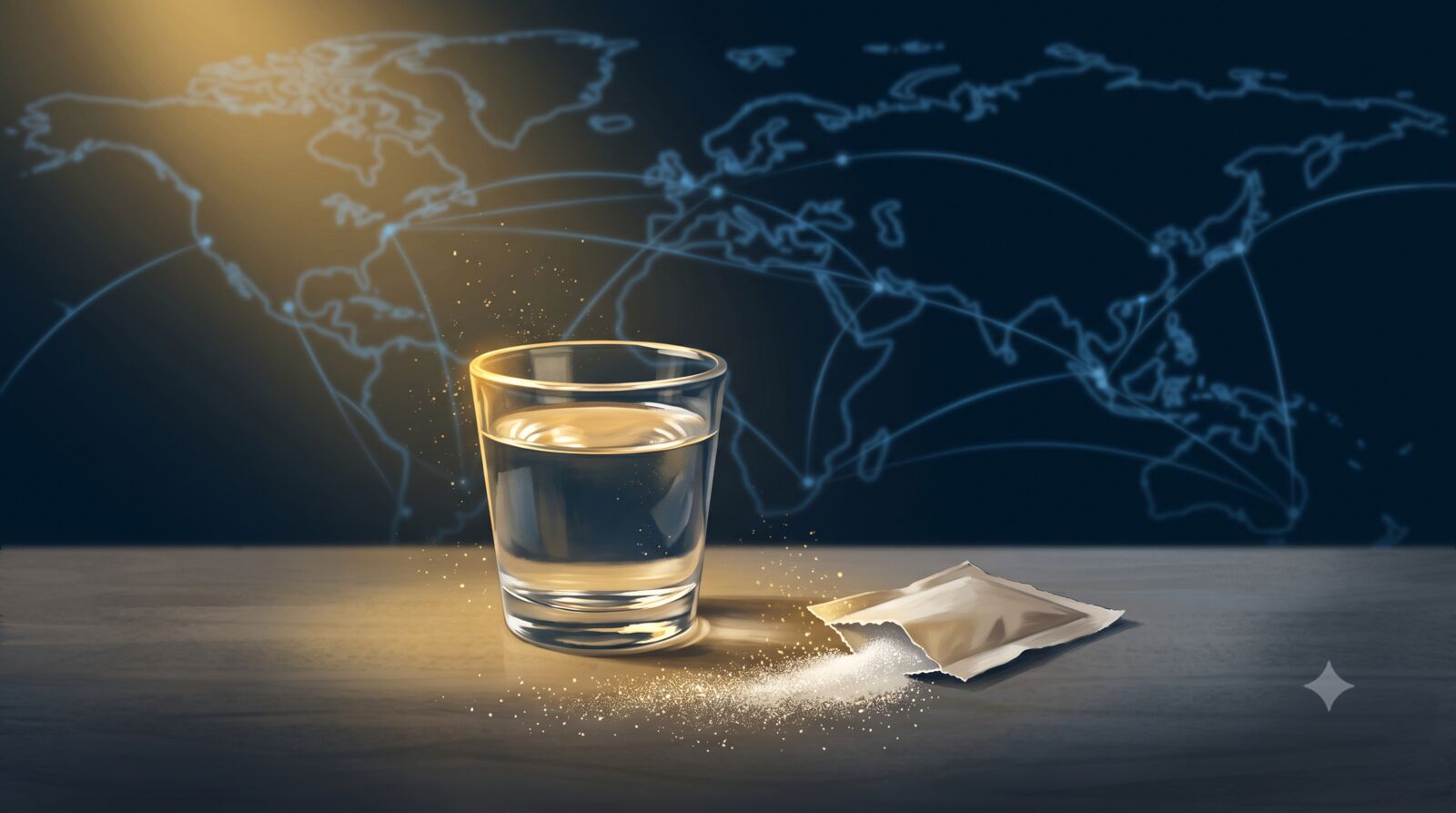
A packet of sugar and salt, stirred into water, costs about 15 baht, well under a dollar. Mixed correctly and given in time, it can take a cholera patient's odds of dying from as high as 50 percent down to less than 1 percent. That single fact was the centerpiece of a recent episode of Students Incorporated, the student-produced podcast at the International Community School of Bangkok, and Mr. Paul, who teaches general and AP biology at ICS, offered it as more than trivia. He used it to answer a question every biology student eventually asks a teacher: why does any of this matter?
A Toxin, a Cell, and a Packet of Salt
The mechanism Mr. Paul described on the show is straightforward once you see it, and almost invisible until someone points it out. Cholera bacteria, usually picked up from contaminated water, release a toxin that hijacks the same cells in the small intestine responsible for absorbing glucose. That disruption causes water to pour out of those cells into the gut, and with it goes the glucose and sodium the body needs to pull water back in. The result is severe diarrhea, and, without treatment, potentially fatal dehydration within hours.
The fix works because it targets the exact mechanism the toxin breaks. Glucose and sodium travel into intestinal cells together, through the same transport pumps, so a solution containing both can restart the process the toxin shut down even while the infection is still active. "Who would have known how to design this treatment," Mr. Paul asked his co-hosts, Mia and Frank, "if they didn't understand the whole system of how your cells take in glucose and what the cholera toxin does?"
Who would have known how to design this treatment if they didn't understand the whole system of how your cells take in glucose and what the cholera toxin does?
That treatment is oral rehydration therapy, and it is not a minor footnote in medical history. Researchers working through cholera epidemics in what is now Bangladesh in the 1960s and 1970s discovered that the glucose-sodium co-transport mechanism let patients rehydrate by mouth just as effectively as with intravenous fluids, a discovery The Lancet later called "the most important medical advance of the 20th century," per reporting on the therapy's history. It replaced a treatment that required trained staff, sterile IV equipment, and hospital beds with something a parent could mix at a kitchen table.
The Fix Is Losing Ground
What makes Mr. Paul's example land harder now than it might have a few years ago is that cholera itself is resurgent. The World Health Organization's multi-country cholera situation reports show 2025 closing with more than 614,000 cases and roughly 7,600 deaths reported globally across five WHO regions, surpassing 2024's toll of just over 6,000 deaths, which was itself already a 50 percent jump over 2023. The Eastern Mediterranean region, driven largely by outbreaks tied to conflict and damaged water infrastructure, and the African region have absorbed the bulk of the deaths.
None of that reflects a scientific mystery. The treatment Mr. Paul described has been standard practice for half a century and, per WHO guidance, can successfully manage the large majority of cases when it reaches patients in time. What is failing is delivery: clean water systems, supply chains, and access in conflict zones and disaster areas, not the biology itself. That gap between a fully understood solution and a rising death toll is precisely the point Mr. Paul was making to a studio full of teenagers: understanding how a system works is what makes it possible to fix, and to notice when it's being applied and when it isn't.
He extended the same logic beyond disease. Asked about biology's relevance to everyday judgment, he brought up a social media post claiming honey loses its "live enzymes" if touched by a metal spoon, a claim that collapses the moment you know an enzyme is a protein, not a living thing, once it leaves a cell. It's a smaller stake than a cholera outbreak, but the underlying argument is identical: baseline scientific literacy is what stands between a person and a claim "promising bigger than they really are."
A Second Teacher, a Harder Sell
The episode's second half made a version of the same case for a subject with a much worse reputation for real-world relevance: calculus. Mr. Jeremy, ICS's calculus teacher of 18 years, was candid about the limits of his own subject. "I've never used calculus at the grocery store or while driving through traffic," he told the hosts. "It is a specialized thing."
But specialized doesn't mean unused. Mr. Jeremy pointed to finance, medicine (dosage curves for how a drug dilutes in the bloodstream over time are a calculus problem), and, pointedly, artificial intelligence, which he said "is founded in the mathematics" even when nobody using it ever sees an equation. That claim holds up under scrutiny: the algorithm that trains most modern AI systems, backpropagation, works by repeatedly applying a single calculus tool, the chain rule, to figure out how to adjust a network's internal settings after each mistake. Every large language model and image generator built in the last decade runs on that same 300-year-old piece of math, invisible to the people typing prompts into it.
The Fight Over Whether Calculus Is Worth It
That invisibility is exactly what's fueling a live argument in American higher education about whether calculus deserves the outsized weight it carries in college admissions, a debate that gives Mr. Jeremy's segment a sharper edge than it might have had a year or two ago. A 2024 survey by the National Association for College Admission Counseling and the nonprofit Just Equations found that 89 percent of college admissions officers believe students who take calculus in high school are more likely to succeed in college, even though fewer than 5 percent of colleges formally require it. Nearly half of officers said skipping it limits a student's options.
Critics presenting at NACAC's 2025 conference argued that treating calculus as a proxy for rigor punishes students who never had access to it in the first place: only about 35 percent of high schools where more than three-quarters of students are Black or Latino offer a calculus course at all, and fewer than 10 percent of students at high-poverty schools complete one, according to federal data cited at the panel. A 2025 Thomas B. Fordham Institute study tracking millions of Texas students over nearly two decades found calculus-takers were no more likely than statistics-takers to finish a degree, though they were likelier to attend more selective colleges. Caltech dropped its calculus requirement two years ago over exactly these access concerns, building alternate pathways for students to demonstrate math readiness instead.
Mr. Jeremy's own advice to the show sidesteps that fight in a useful way. His counsel to a student weighing more math after high school wasn't to grind through problem sets for the sake of a transcript line, "that's not really what you do," he said, but to chase the harder question of why a technique works at all, since that's the kind of understanding a calculator, or now an AI model, can't replace.
Two Teachers, One Argument
Neither guest was arguing that every student needs to become a biologist or a mathematician. Mr. Paul's closing point traced back to ICS's own mission statement, which frames the goal of a class as "wisdom for the good of our world," not just a transcript entry. Mia, the co-host interviewing both guests, isn't headed toward either field; she said partway through the episode that she's set on law, not medicine or math. But by the end of the hour, she'd landed on the same idea running under both interviews: it wasn't until she understood the reasoning behind cholera treatment and calculus that she understood why people spend careers on them at all.