 Students Incorporated
Education
In Bangkok's Language Classes, Culture Comes Before Grammar
ICS Bangkok teachers on why Mandarin, Thai, and French resist word-for-word translation, and why a 400-year-old French academy still guards the language.
The Académie Française has forty members, all writers, all elected for life, and all known, officially since the 1600s, as "the Immortals." Their job, unchanged since Cardinal Richelieu chartered the institution in 1635, is to decide what counts as correct French: which words belong in the dictionary, which spellings are acceptable, which usages get to survive. It's the most extreme version of an idea that ran through a recent Students Incorporated episode, in which three International Community School of Bangkok (ICS Bangkok) teachers spent an hour making the same point from three different languages: you cannot learn a language without learning the culture wrapped around it, and treating the two as separable is where both translation and language education go wrong.
Guarding a Language Like a Treasure
Ms. Amy, ICS Bangkok's high school French teacher, put it plainly. "You really cannot separate language and culture," she told the show's hosts. "You really just can't." She spent the segment walking through why: literature is embedded at every level of French schooling, publishing a book is treated as one of life's higher achievements, and the language itself is protected by an institution most Americans have never heard of.
The Académie Française isn't ceremonial. Its forty seats open only on death, candidates must already be published authors, and members are chosen by the sitting Immortals themselves, a self-perpetuating body that has argued over the French language for nearly four centuries. Its most public fight in recent memory came in 1990, when the Académie backed rectifications trimming roughly 2,400 words, including the circumflex accent from words like maîtresse. The changes sat mostly unused for over two decades until French textbooks adopted them in 2016, at which point the backlash arrived on social media under the hashtag #JeSuisCirconflexe, "I am circumflex." The Académie's ninth edition dictionary, published in 2024, added more than 21,000 new words.
You really cannot separate language and culture. You really just can't.
That instinct to guard rather than simplify is, Ms. Amy said, the point. "They kind of like the fact that their language has some difficulties that make it a little bit harder to master. They think that the beauty is in the difficulty and the complexity." No English-speaking country has anything comparable, since English has never had an official regulating academy, which is part of why the two languages handle borrowed phrases so differently, and part of why French and English share so much vocabulary in the first place. An estimated third of modern English vocabulary traces back to the Norman Conquest of 1066, when French became the language of England's nobility, courts, and administration for roughly three centuries and left thousands of words behind.
What Doesn't Translate
That shared history shows up in how directly some English and French idioms line up. "Piece of cake" becomes "c'est du gâteau," literally "that's cake." "Killing two birds with one stone" becomes "faire d'une pierre deux coups," to make two blows with one stone. Where the two languages split is where the underlying image is culturally specific rather than just linguistically borrowed. "The clothes don't make the man" becomes "l'habit ne fait pas le moine," the robe doesn't make the monk, a swap that only works in a culture where the monastic habit was a recognizable visual shorthand for virtue.
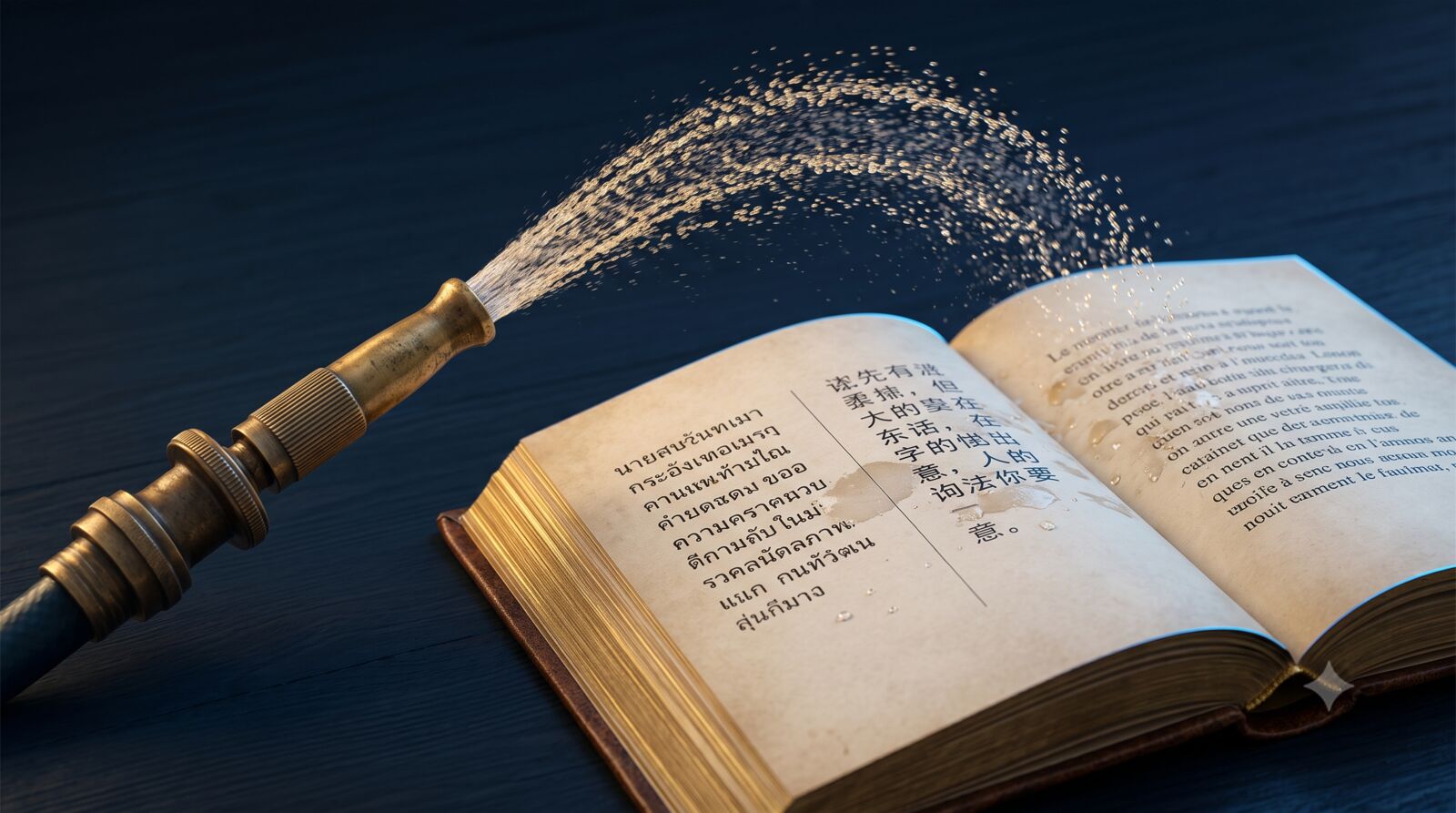
The best example Ms. Amy offered was "getting a taste of your own medicine," a phrase with no real French equivalent because, as she put it, a French listener would just be confused about why anyone was tasting medicine. The actual French expression is "l'arroseur arrosé" (the waterer, watered), and it traces back to a specific, real source: a French comedy from 1895 in which a gardener is watering his garden when a boy sneaks up and steps on the hose. When the gardener lifts the nozzle to see why the water's stopped, the boy releases his foot and sprays him in the face. That film, "L'Arroseur Arrosé," was shot by the Lumière brothers in Lyon and first shown publicly on June 10, 1895, making it not just the source of a French idiom but one of the earliest comedies and first fictional narratives ever put on film, more than a century before anyone in Ms. Amy's classroom was born.
The Neuroscience, Checked
In the episode's other segment, Ms. Jing, ICS Bangkok's Mandarin teacher, made a more clinical case for language study: that bilingualism changes how the brain works, not just what it knows. The scale claim she opened with needs a small correction: Mandarin is spoken by well over a billion people worldwide, not the smaller figure suggested on air, with roughly 940 million native speakers alone, more than double English's native-speaker count, according to recent global language rankings. That still makes it one of two languages, alongside English, with more than a billion total speakers.
Her underlying point about cognition holds up better than the numbers she used to describe it. Research on bilingual brains consistently finds that managing two language systems strengthens attention, working memory, and inhibitory control: the ability to suppress irrelevant information, since a bilingual brain is effectively suppressing one language every time it produces the other. A 2025 review in the EuroGlobal Journal of Linguistics and Language Education found bilingualism enhances executive function and cognitive flexibility, and some longitudinal work suggests it may help delay cognitive decline later in life. Researchers do flag nuance, though: the advantage depends on proficiency level, age of acquisition, and how consistently both languages get used, a caveat that maps onto something else Ms. Jing said, about learning being less a switch you flip than a habit built over years.
A Grammar Built Around Rank
Kru Siraporn, ICS Bangkok's Thai teacher and a 26-year veteran of the school, made a different but related argument: that Thai encodes social relationships directly into which words you're allowed to use. "We have the language that we talk with only friends," she explained. "The language was used with our parents, to our cousin, relative, teacher, and to use with our boss." Getting the register wrong doesn't just sound clumsy in Thai, she said; it actively signals disrespect, in a way vocabulary alone can't fix. It's a more formal version of a pattern that shows up across much of Asia and parts of Europe, where a language's grammar tracks who you're talking to and how much deference the relationship requires, long before a sentence gets to its actual content.
Why the Trouble Is the Point
All of it, the Immortals, the untranslatable idioms, the neuroscience, the Thai registers, points at the same underlying stakes. UNESCO estimates that roughly 40% of the world's nearly 7,000 living languages are endangered, with one disappearing at a rate of roughly one per month absent intervention, and more than 400 languages have gone extinct in the past century alone. What's lost with each one isn't just a set of words with English equivalents sitting in reserve; linguists studying endangered languages have documented ecological and cultural knowledge, terms for local plants, animals, and practices, that simply doesn't exist in bigger, more dominant languages, because it never needed to travel that far to be useful.
That's the case ICS Bangkok's teachers were quietly making just by having the conversation. A campus running Mandarin, Thai, and French instruction side by side, for a genuinely international student body, is a small bet against the version of globalization where everyone defaults to whichever language is most convenient. The Immortals guard French through legislation and a four-century-old institution. A gardener getting hosed in the face in 1895 accidentally coined an idiom that outlived the joke by 130 years. A Bangkok classroom does its version of the same work with considerably less pomp: one vocabulary list, one cultural rule, one grammatical register at a time.