 Students Incorporated
Entrepreneurship
How La Mesa Coffee Is Betting on Thailand's Farmers
Bang Na café owner Gary Ford II ties Bangkok's specialty coffee boom to hill-tribe farmers in the north, as climate change reshapes both futures.
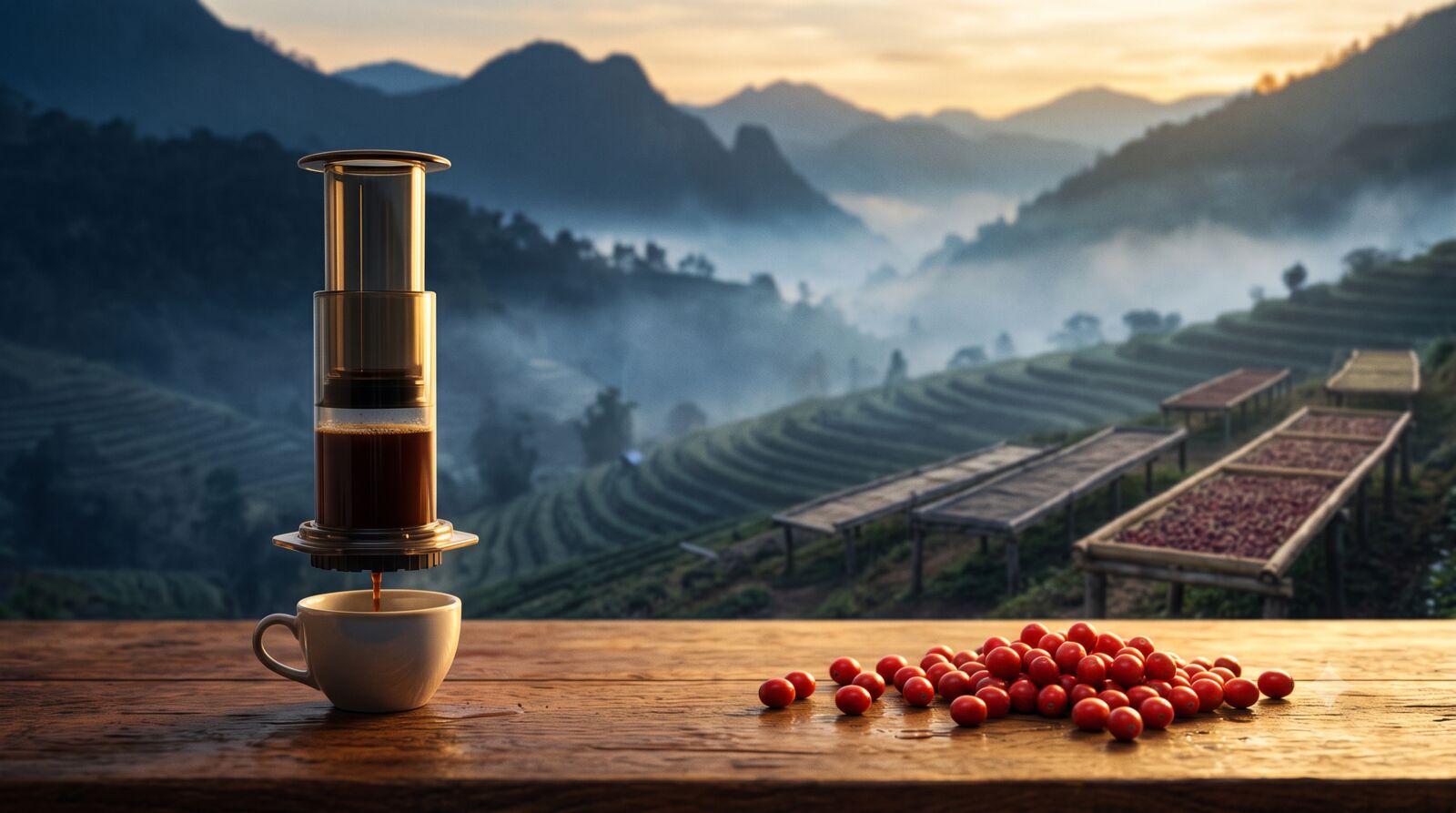
At a café in Bangkok's Bang Na district built to look like New Mexico's high desert, Gary Ford II is fighting two fronts at once: too many coffee shops chasing too few loyal customers, and a warming climate quietly shrinking the map of where coffee can even grow. Ford, who owns La Mesa Coffee Co. with his wife, Michelle Ford, sits closer to both problems than most café owners. He buys beans grown a short flight and a mountain drive from his own counter, in a country that drinks far more coffee than it produces. That contradiction, and what Ford is doing about it, came up in an extended conversation on the Students Incorporated podcast, recorded with hosts from ICS Bangkok.
A Saturated Market, One Cup at a Time
Bangkok does not lack for coffee shops. Ford, an Albuquerque native who opened La Mesa four years before the interview in the then-underserved stretch of lower Sukhumvit near Bang Na, said the standard advice for surviving a crowded market starts with a blunt question: is the product actually needed, or is it just occupying space? "Good business always fulfills a need," he said, "and I believe that good products sell themselves." La Mesa's answer was to lean hard into specificity: an American-inflected fusion of New Mexican food (Michelle Ford runs the bakery program, turning out New York cheesecake and flourless chocolate cake alongside brunch burritos) built around a full espresso and drip program, with alternatives for customers who don't drink coffee at all. The café's adobe-arch, succulent-filled interior, styled after Ford's home state, has made it a photogenic draw in its own right, a detail Bangkok's BK Magazine picked up in its own writeup of the space.
Ford's baseline standard is uncompromising in a way that doubles as his pitch to other food-and-beverage owners eyeing a saturated field:
If it's okay, we don't want it.
That category has an industry name: third-wave coffee, treating the trip from seed to cup as "a fine art and science," in contrast to mid-20th-century convenience coffee (the first wave) and the taste-forward but often flavor-additive-heavy chains, epitomized by Starbucks, that defined the second wave starting in the 1990s. Thailand's own third wave has been expanding fast: trade outlet Perfect Daily Grind puts annual growth in the country's specialty segment at roughly 15 to 20 percent, concentrated in Chiang Rai province, which alone produces around 60 percent of Thailand's arabica crop.
A Costume, a Push-Up, and a Blind Panel
Ford's proof of commitment to that craft came a few weeks before the interview, when he competed in a Thai regional AeroPress competition, a format he described, tongue only partly in cheek, as "coffee Olympics." He was one of 99 entrants working with the same secret coffee, tasked with building a brewing recipe and defending it in front of certified judges who cup the entries blind, unable to see who made what. Costumes are common; past competitors have dressed as Pokémon. Ford's routine leaned into theater instead: a "coffee meditation" opening followed by a one-handed push-up performed while pressing the brew, done in front of a crowd that, in his telling, had no idea what was coming. "They're kind of like facing the other direction, but they could hear all this happening behind them," he said of the judges. "What is Gary up to?"
He credited the device itself to "the guy that created the Wham-O frisbee." The AeroPress's actual inventor, Alan Adler, never worked at Wham-O; he built his name on the Aerobie flying ring, a rival product launched through his own company in 1984, before prototyping the AeroPress in his garage two decades later. The AeroPress has since become a legitimate global sport in its own right: Adler's company launched the World AeroPress Championship in 2008 with three competitors, and by 2024 it had grown to roughly 6,000 entrants across 164 contests in 64 countries. Ford made it to the semifinals with a deliberately gentle, low-agitation brew built around "light lychee" notes, a lighter profile than the eventual winner's. He didn't take the title. He said he'd do it again.
From Opium Fields to Espresso Bar
The more consequential part of Ford's business isn't the competition circuit. It's where the beans come from. He and Michelle got into coffee through medical mission work in hill-tribe villages in northern Thailand, and that relationship has since become operational: La Mesa works directly with small growers, funding infrastructure like drying beds so farmers can shift from basic washed processing to more distinctive methods that command higher prices. "We're only about two hours in theory from a farm," Ford said: an hour's flight north, then an hour up a mountain.
Those villages sit inside a longer regional story that gives Ford's sourcing work real weight. Northern Thailand's hill-tribe coffee economy traces back to the late 1960s, when Thailand's Royal Project Foundation, established under King Bhumibol Adulyadej in 1969, introduced arabica varieties to Akha, Lisu, Hmong, and Karen communities as an alternative to opium poppy cultivation in the Golden Triangle. Growers who once lacked land rights, citizenship, or reliable income have built an export-grade industry on that foundation; social enterprises such as Akha Ama Coffee, founded by Akha graduate Lee Ayu Chuepa, now produce single-origin lots processed with techniques that didn't exist in the region a generation ago, according to the Chiang Rai Times. Ford's drying-bed investments plug directly into that same push for differentiated processing and better farmgate prices.
Thailand's Rare Double Life
What makes Ford's supply chain unusual isn't just its length. It's the country it runs through. "We drink a lot of coffee in Thailand, but then also we're a country that produces coffee," Ford said. "To be honest, this is rare in the world, especially to our scale." The data backs him up: Thailand ranks only around 20th among coffee-producing nations, well down from a top-15 spot a decade ago, even as domestic demand has outpaced local growers. Per-capita consumption has nearly doubled over the past several years, from roughly 180 cups annually to about 340, pushing the domestic coffee market to an estimated 65 billion baht in 2025, even as the country produces only around 5,000 tonnes of coffee that qualifies as specialty-grade. That gap is precisely why direct relationships with growers, rather than commodity purchasing, have become the norm among Bangkok's better cafés.
The Climate Clock Nobody Can Stop
The conversation's most pointed moment came when Ford was asked to look ahead at the industry's next decade. He didn't hesitate before naming the threat: "Climate change has a major effect on the coffee industry." He referenced an oft-cited but loosely defined "coffee crisis," suggesting a window of roughly 12 to 15 years before major shortfalls hit, and pointed to Thailand's own 2021 harvest, damaged by unusually heavy rain. His co-host, only half-joking, called the framing alarmist, a fair instinct, since the "no more coffee" framing tends to overstate the mechanism. The actual research is narrower but still serious: a Rabobank analysis found that about 8 percent of current arabica-growing land worldwide is already climatically unsuitable, a share that could reach roughly 20 percent by 2050. The damage lands unevenly: Brazil's share of harvest from suitable land could fall from 81 percent to 62 percent, and Honduras could see suitable growing area shrink to just 12 percent of its current footprint, while Ethiopia's suitable zones are projected to expand. None of that predicts coffee vanishing on a fixed countdown; it predicts the kind of disruption that makes direct, invested relationships with specific farms (the kind Ford paused during Covid and has been rebuilding since) look less like a marketing choice and more like a hedge.
That's the throughline connecting a push-up stunt in an AeroPress semifinal to a drying bed in a northern Thai village: in a market this saturated and a climate this unstable, the café owners paying closest attention to where their coffee comes from are the ones positioned to still have some when the easy supply runs thinner.