 Students Incorporated
Education
How an ICS Bangkok Marketing Class Built a Global Podcast
Students Incorporated's first season wrapped with listeners in over 23 countries, proof a high school marketing class can scale like a real company.
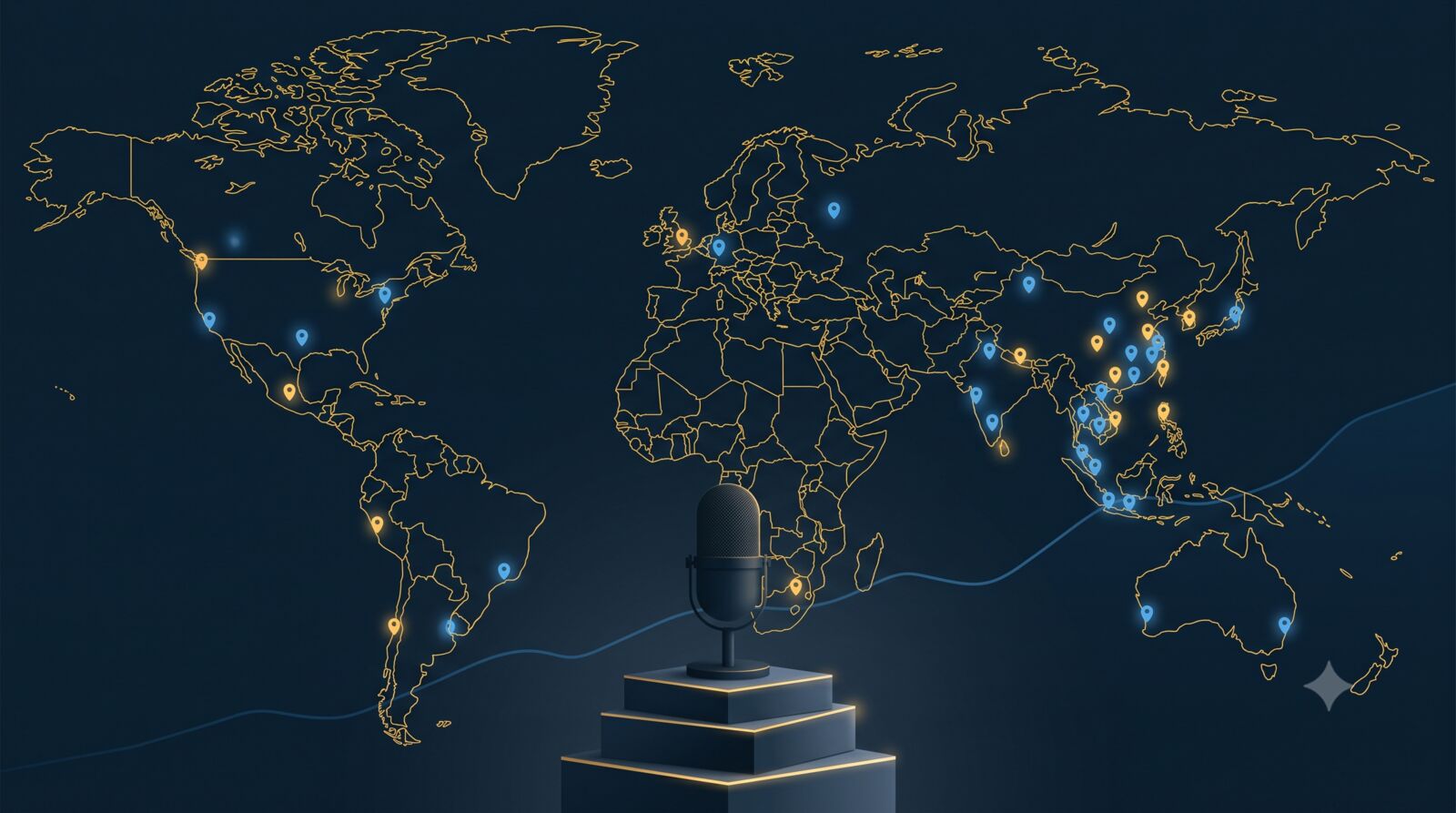
A high school marketing class does not usually end its year by reading out download numbers from a dozen countries it has never visited. But when the students behind Students Incorporated closed out Season 1 of their podcast in May 2023, that is exactly what happened: more than 3,000 downloads, listeners logged in over 23 countries, distribution on seven platforms, and, for a stretch, a spot in the top 10 business podcasts in Thailand. All of it came out of one class period at the International Community School of Bangkok, taught by Jason Weimer, in a single school year.
The season finale, titled "It's a Falafel Wrap," played less like a class project wrapping up and more like a company's annual all-hands: a rundown of metrics, a round of superlative awards for the "employees," and an announcement that the whole operation would be restaffed from scratch in the fall. That structure is the actual story here. Long before Students Incorporated became a multi-season show that would go on to interview business leaders, researchers, and public figures, its first cohort had to answer a more basic question: could a classroom actually produce something the outside world would listen to?
A Newsroom Dressed as a Class Period
The finale's own recap makes clear the class wasn't just recording conversations. It was running a small media operation with defined jobs. Season 1 produced 32 episodes and more than 39 interviews, and the team says it researched and reported roughly 90 news stories along the way. They recorded one live show in front of several hundred students and staff, a stunt that the crew's own retelling admits nearly fell apart when half the team came down sick beforehand. The season also inspired spinoff episodes aimed at younger students at the school, proof, if nothing else, that the format had an appetite for repetition.
The finale's awards ceremony treats those functions like the departments of a real company. There was a "Meeting Man" award for the most organized member of the team, given to a student named Machi for keeping the production on schedule. A "Peacemaking Producer" award went to a student called PK for keeping the team's quality control and morale intact. Tazia won a "Radiant Reporter" award for tracking news stories; Lyon won "Viewable Voice" for on-air presence; Darren, described on the show as the team's "only Scandinavian," won a "Snowy Social Student" award for handling guest relations; Linda was recognized for running the show's social media accounts and photography; Ronnie, credited as the team's writer and editor, won "Super Scriber"; and Kush, the show's engineer, won "Saucy Sound Man" for handling recording and mixing. The show's teacher, Jason Weimer, was given what the students called the "Grand Godfather GOAT Award," a nod, delivered half as a joke and half sincerely, to running the entire production like a business owner would.
That last detail is not incidental. It captures what the class was actually built to simulate: a workplace with a boss, defined roles, deliverables, and metrics to hit, inside a semester, not a career.
The Numbers a Class Project Doesn't Usually Have
What makes the finale worth reading as more than a nostalgic wrap-up is that the numbers are real distribution numbers, not classroom self-assessment. The show was live on Spotify, Apple Podcasts, YouTube, Amazon Music, Samsung Podcasts, Stitcher, and Google Podcasts, the standard footprint of an independent podcast trying to reach every major listening app at once. By the finale, the crew reported more than 3,000 downloads and listeners in more than 23 countries, including Spain, Belgium, the Philippines, Australia, the Netherlands, Brazil, India, Malaysia, France, Canada, South Korea, the United Kingdom, Japan, Germany, Mexico, Indonesia, Nigeria, Singapore, and the United States.
For a class assignment, that reach is unusual. It's less unusual for a podcast produced out of Thailand generally, one of the more engaged podcast markets in the world. A 2025 YouGov Global Profiles survey found that 54% of Thai consumers listen to podcasts for at least an hour a week, a figure second in the Asia-Pacific region only to Indonesia's 59%, putting Thailand ahead of much larger media markets on pure listening habit. Analysts tracking the region have pointed to Thailand, Indonesia, and India as the fastest-growing podcast markets in Asia-Pacific heading into 2026, driven by cheap production tools and the spread of podcast content onto YouTube and TikTok as much as dedicated podcast apps. Globally, the audience these students were tapping into had nearly tripled in size in under a decade: worldwide podcast listenership grew from around 274 million in 2019 to roughly 670 million in 2026, according to industry tracking, alongside a podcasting market now estimated near $62 billion a year. A single high school class landing in that current, even briefly, in a top-10 business podcast slot in its home country, says something about how low the barrier to real distribution has fallen, not just about the students' effort.
Why the Format Kept Working
The class's structure, a teacher running a simulated company, students rotating through defined production roles, a hard deadline every week, maps closely onto what education researchers call project-based learning, and the evidence for it is stronger than "it felt engaging." A 2023 meta-analysis in Frontiers in Psychology, led by researchers Lei Zhang and Yunsong Ma, reviewed 66 experimental and quasi-experimental studies on project-based learning and found it significantly improved academic achievement, critical thinking, and student engagement compared with traditional instruction, and specifically flagged high school-level implementation in Asian educational settings as where the approach showed its strongest effects. That is close to a direct description of what Students Incorporated is: a project-based assignment, run in a Bangkok high school, structured around real deadlines and an external audience rather than a grade alone.
"This is not a hard goodbye for Students Incorporated. It's more of a see you later or catch you on the flip side."
That line, from Jason Weimer near the top of the finale, previewed the mechanism that would let the show outlast any one group of students: the class itself doesn't graduate. Season 2 was announced to begin that September with an entirely new roster of marketing students stepping into the same roles (meeting organizer, producer, reporter, host, social media lead, writer, engineer), because, as the finale makes explicit, most of Season 1's crew were leaving ICS Bangkok for good. The show wasn't built around a cast. It was built around a curriculum, which is why it could survive turning over its entire staff annually and still add episodes for years afterward.
An Ending Built Into the Format
The finale closes on a line the crew treats as its own kind of moral: "all good things must come to an end," attributed on-air to a 14th-century poet whose name gets fumbled in the recording. The sentiment traces to Geoffrey Chaucer, whose Troilus and Criseyde, written around 1374, includes the line "but at the laste, as every thing hath ende," though language historians note the modern phrasing, with "good" inserted, took shape well after Chaucer's time. Loose attribution aside, the idea fit what the class had actually built: a show engineered to end every May and restart every September, on schedule, with new people, because the ending was never a failure state. It was the plan.
Season 1 wrapped with 32 episodes, a download count in the thousands, and a roster that would scatter to graduation within weeks. What it left behind wasn't a finished product. It was a template sturdy enough that a new class could pick it up cold each fall and keep it running, which, several seasons and dozens of episodes later, is exactly what happened.