 Students Incorporated
Education
From TV Carts to ChatGPT: What Veteran Teachers Say Changed
Five international-school teachers with decades in the classroom were asked what changed most in their careers. All five gave the same answer.
Five teachers at a Bangkok international school were asked, one after another, what had changed most since they started their careers. None of them said curriculum, testing, or classroom management. Every one of them, independently, named the same thing: technology, and how much faster it now moves.
The setting was a "Back in the Day" segment on episode 67 of Students Incorporated, the student-produced podcast at the International Community School of Bangkok (ICS Bangkok), where hosts Mia and Frank rotated five faculty members through an identical set of questions. Stacked together, the five answers formed an accidental record of what a classroom gains and loses each time a new tool arrives, ending with the newest and fastest-arriving one yet.
Same Question, Five Careers, One Answer
The five teachers didn't share a common path into education. Mr. Dan, a high school English teacher, first joined ICS Bangkok in 2016 and returned this school year after two years away. Prof. Carly, who teaches Spanish, has been at the school on and off since 2009, including a stretch that began mid-pandemic. Mr. Johan, who teaches Thai, has spent 18 years at ICS Bangkok in a career that started in Chiang Mai more than 25 years ago. Brad McKenzie, the school's ninth-grade English teacher and yearbook adviser, started teaching in 1995. Miss Vicki, the newest of the five, is in her third year teaching high school math after attending a large public high school in the United States.
Ask that range of educators what changed most and you'd expect a range of answers: a shift in standards, a new curriculum framework, a different kind of student. Instead, all five converged on the same word within seconds. "I think the major thing is technology, because in the past, when I started teaching, we didn't have laptop," Mr. Johan said. "We didn't have a copier or a scanner or even printer." Prof. Carly answered almost identically: "the biggest shift, for better or worse, is technology... it really blew up during COVID because of online learning." Brad McKenzie put a number on how much ground that shift has covered inside one career: "I've been teaching now for about 25, 26... years, and I would imagine the next five or 10 will see even more amazing changes going on there, too."
From the TV Cart to the Algorithm
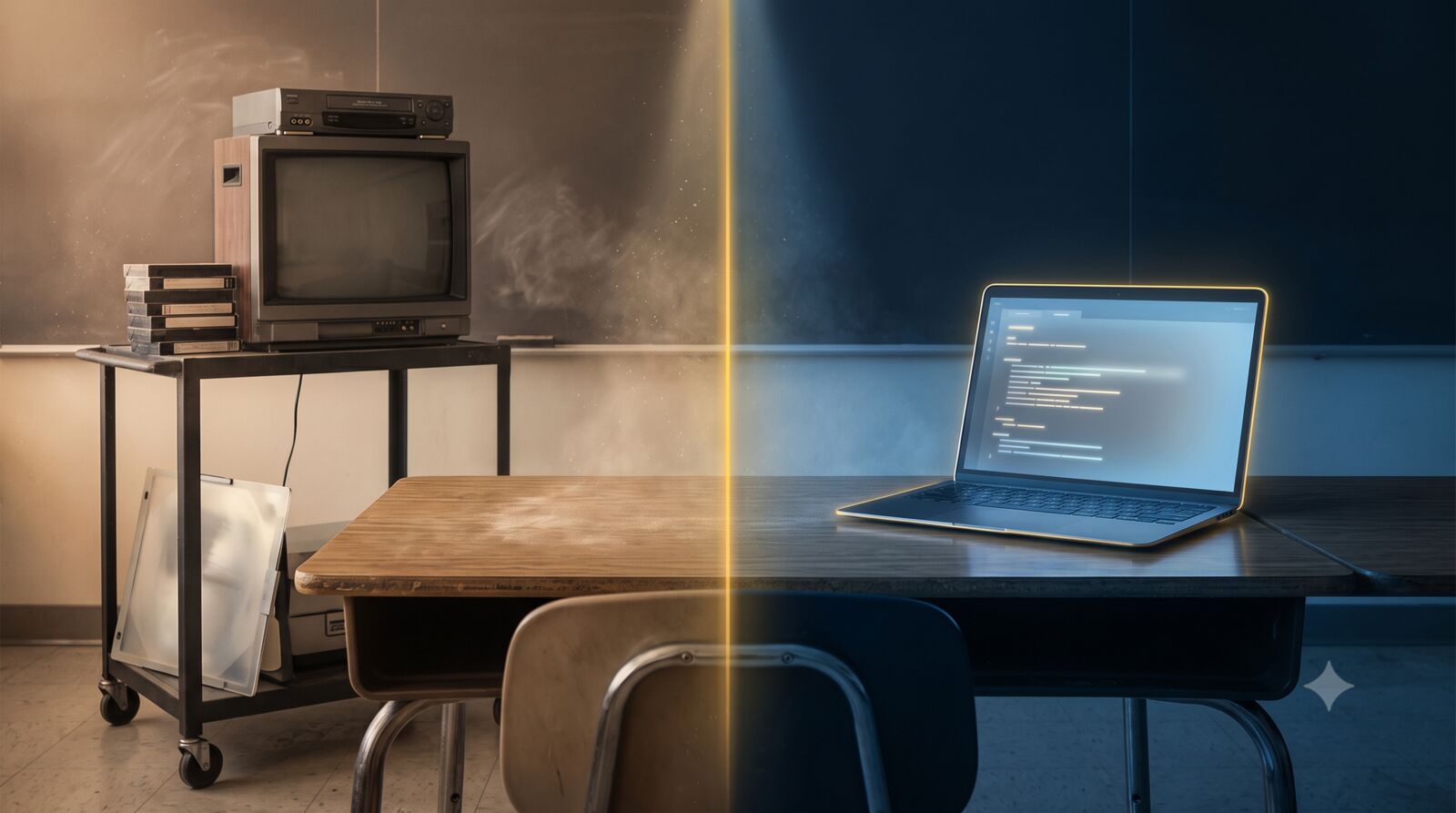
For Mr. Dan, the marker of that shift is oddly specific: a metal cart with a television and VCR strapped to it. "We didn't have projectors in the classroom back then. We had TV carts with VCRs and educational VHS tapes," he said. "As soon as we saw a teacher come in with a TV cart, we knew that we were going to get something a little bit different from the everyday." That tracks with the broader history of classroom technology: VHS tapes and VCRs replaced 16mm film projectors in American schools during the 1980s, and rolling carts became standard equipment for the rest of the century, per a history of classroom audiovisual equipment in EdTech Magazine.
Brad McKenzie's version of the same memory runs through different hardware, arriving just as it was already becoming obsolete. "The two main tech things they taught us was how to insert slides into a slide projector and how to slice a film reel if the film projector happened to chew it up," he said of his teacher training in the mid-1990s. He still remembers his first thumb drive, an 8-megabyte model, and the year his school's yearbook photo submissions shifted from a pile of physical photos to a digital folder. The overhead projector he trained on, developed by 3M physicist Roger Appeldorn, had been standard classroom equipment since the early 1960s; 3M didn't stop manufacturing the machines until 2015, a run longer than most of what has replaced it since.
Both men's classrooms have now landed in the same place: a race, as Brad McKenzie called it, to figure out generative AI. "AI is now the big one," he said, "because I mean, as students and as teachers, we're all kind of racing to catch up to this thing and figure out how best to use it." By the 2024-25 school year, six in 10 U.S. teachers reported using some kind of AI tool for their work, and three in 10 were already using one at least weekly, per a Walton Family Foundation and Gallup study published in June 2025; weekly users said it saved them an average of 5.9 hours a week. Not every teacher is sold, though: a separate 2024 Pew survey found roughly a quarter of U.S. teachers believe AI tools do more harm than good in K-12 education.
The Attention Problem Nobody Assigned
Where Mr. Dan and Brad McKenzie focused on hardware, Prof. Carly focused on what it trained students to expect. "Kids these days are just so used to instant gratification and feedback and entertainment through video games, through social media, through access to apps that have gamified every type of learning," she said. "So when they're not on a screen, they often feel bored quickly." She drew a direct line from that shift to how she now has to teach: "students want to be entertained in the classroom, and they lose interest quickly if their teacher is not entertaining enough."
A 2024 Pew Research Center survey found 72 percent of U.S. high school teachers see cellphone distraction as a major classroom problem, compared with 33 percent of middle school teachers and just 6 percent of elementary teachers. Prof. Carly's proposed fix wasn't to ban any one tool but to rebalance: "there's really a place for traditional teaching methods, but everything in moderation, nothing in excess... like memorization, knowing how to decipher a textbook, physically taking notes."
More Connected, and Somehow Less Close
Mr. Johan's answer went furthest past the classroom, into a paradox that shows up repeatedly in recent research on adolescent technology use. "Even we have social media," he said.
It should make us closer, but somehow we cannot connect with the people.
He contrasted that with his early years at ICS Bangkok, when he says he and his students "talked face to face a lot" and spent time together outside class, one student even attended his wedding. "Now today," he said, "it's hardly to do that and talk with personal student a little bit so far."
That's more than sentimentality. In June 2025 testimony to the U.S. House Committee on Education and Workforce, psychologist Jean Twenge said lax school phone policies have coincided with falling teacher morale, rising loneliness, and falling academic performance, citing a Norwegian study in which middle schools that banned smartphones saw better performance, less bullying, and improved mental health, especially among girls. Mr. Johan's read on the paradox, more channels for contact, less actual connection, echoes what that research keeps finding from a different direction.
The One Tradition Nobody's Sorry to Lose
Not every "back in the day" memory involved a screen. Miss Vicki's contribution went to a tradition her American public high school retired the year before she started as a freshman: a hazing ritual called "push a penny," where seniors made freshmen race down a hallway pushing a coin with their nose. "Thankfully for me, my older sister was a junior when I was a freshman," she said, "so I would have been like the first choice to be her servant." A broken ankle the week before spared her. "They really cracked down on that with the bullying and hazing traditions," she said. "I'm glad that no longer exists."
Her school got there years ahead of federal policy: the Stop Campus Hazing Act, the first federal law addressing hazing in American education, wasn't signed until December 2024, a generation after her own school phased out the practice.
What Didn't Change
Set against that many overhauls in equipment and expectation, Brad McKenzie's closing thought stood out for what it didn't claim. "The teaching itself hasn't changed a whole lot," he said. "My goal is still to try and help students write to the best of their ability... the teaching doesn't change, but the method that we do it sometimes does." The tools in a classroom have turned over completely, more than once, inside a single career, from TV carts to thumb drives to ChatGPT, while the underlying job, getting a distracted, differently motivated room of teenagers to actually learn something, hasn't moved nearly as much. The hardest part of teaching back in the day, it turns out, wasn't the day. It was, and still is, the room.