 Students Incorporated
Education
From Paper Hats to Chatbots: How School Cheating Escalated
AI has made cheating nearly effortless for students worldwide. The study science these Bangkok teens describe on a recent podcast already beats it.
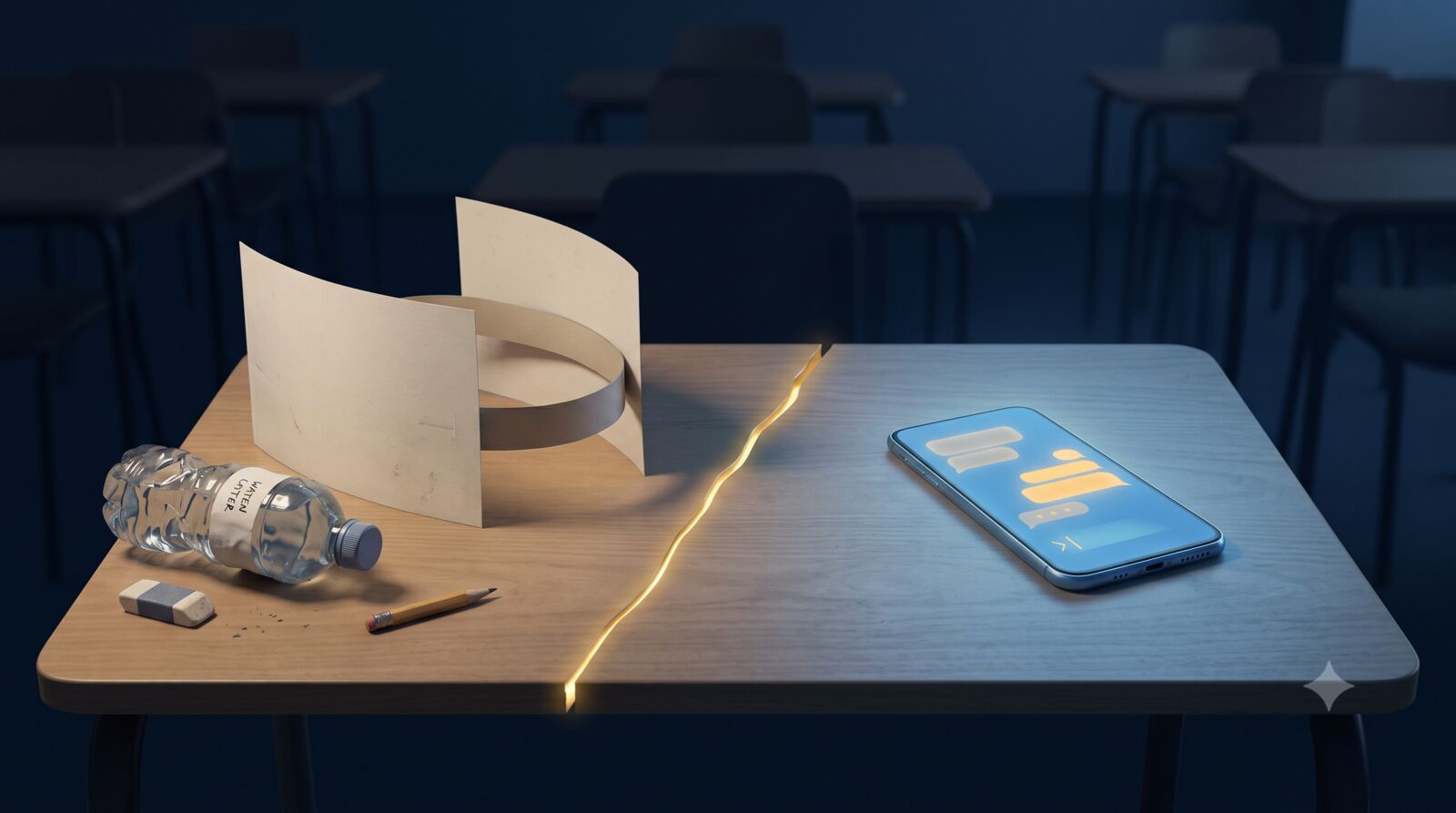
Cheating in schools used to top out at ingenuity: a formula inked on a water bottle label, an eraser code, a coughing pattern rigged to signal answers across a room. It required effort, and that effort kept it contained. That constraint is gone. A chatbot can now write the essay, solve the problem set, and summarize the reading in the time it takes to type a prompt, and most students have noticed. A recent episode of Students Incorporated, the podcast produced by students at the International Community School of Bangkok (ICS Bangkok), spent half its runtime cataloguing how creative school cheating has always been and the other half unpacking study techniques that cognitive scientists say actually work. Put the two halves together and a sharper story emerges: the tools available to cheat have changed by an order of magnitude, but the science of what makes learning stick hasn't moved at all. It was sitting there, the better trade.
A Shortcut With a New Delivery System
The scale shift is not subtle. In its 2025 student survey, the UK's Higher Education Policy Institute found the share of students using generative AI tools for assessments jumped from 53 percent the previous year to 88 percent, with 18 percent admitting they'd submitted AI-generated text as their own work. A separate BestColleges survey found 22 percent of students who believe using ChatGPT constitutes cheating do it anyway. Outside higher ed the pattern starts earlier: Common Sense Media polling has put chatbot use for schoolwork at 54 percent among 13-to-17-year-olds, with roughly one in ten leaning on AI for most or all of their homework.
Co-hosts Patience and Premi opened the episode's news segment with a story that, in hindsight, reads as an early tremor of that shift. In February 2023, a teacher at Cape Coral High School in Florida noticed a batch of essays from the school's International Baccalaureate program shared an oddly uniform style. The investigation found students in the school's most selective academic track had used ChatGPT, then barely three months old, to write IB coursework. It became one of the first widely covered K-12 chatbot-cheating stories in the US, at a school already screened for academic seriousness. That's the uncomfortable part: AI-assisted cheating hasn't been a story about weak students looking for a way to survive a class. It's been a story about capable students discovering a tool faster than the institutions built to catch them.
The Locks Weren't Built for This
Schools' first instinct has largely been detection: running submitted work through AI-checking software. The podcast's hosts flagged this too, noting on-air that such tools are "still not a reliable method for checking originality," a caution that has held up. Universities including UCLA, Vanderbilt, Cornell, Pittsburgh, and Iowa have all stopped using Turnitin's AI detector, and the University of Waterloo dropped it in September 2025 after internal tests flagged human-written text as "100% generated by AI." The error isn't random, either. A Stanford-led study in the journal Patterns tested seven popular GPT detectors on real TOEFL essays from non-native English speakers and found a 61 percent average false-positive rate, versus near-perfect accuracy on essays from native-speaking eighth graders. A separate national survey by the Center for Democracy and Technology, reported by Education Week in 2024, found Black teens falsely accused of AI use at nearly three times the rate of white teens. At a school like ICS Bangkok, where English is a second or third language for much of the student body, that isn't abstract: a false accusation carries real weight for a teenager's transcript and, as multiple studies document, a real psychological cost. Betting on catching AI after the fact means chasing a technology that changes faster than the tools built to police it, with a false-positive rate high enough to punish the wrong students.
An Arms Race That Predates the Chatbot
None of this is new in spirit. The episode's news segment also revisited the 2015 Atlanta Public Schools scandal, in which a state investigation found evidence of test-tampering across 44 schools and roughly 180 educators, and a six-month racketeering trial convicted 11 administrators and teachers, three of whom were initially sentenced to 20 years. That case is a reminder that cheating isn't just a discipline problem for teenagers; adults do it too, when incentive is strong enough and oversight is thin enough. It's also the same logic driving the AI numbers: remove enough friction, or apply enough pressure, and a large share of any population will take the shortcut.
Before AI, that friction was physical and often theatrical. The podcast highlighted a 2013 incident at Kasetsart University in Thailand, where students agreed with their professor to wear paper "blinders," horse-blinker headbands made from two sheets of A4 paper, to block peripheral views of classmates' answers. The photos went viral, the university faced enough backlash to promise never to use them again, and yet the idea persisted. In 2022, mechanical engineering students at Bicol University College of Engineering in the Philippines built anti-cheating headwear from cardboard and egg cartons at their professor's suggestion, some replicating the simpler Thai-style flaps and others going further. Their professor, Mary Joy Mandane-Ortiz, said the stunt worked: students studied harder under the embarrassment of the conditions, and nobody was caught cheating that term. The podcast's own top-10 list of "outrageous cheating methods that probably won't work," read by guest Mrs. Amber, a high school principal, catalogued the same genre closer to home: nail-polish formulas, elastic-band notes, invisible ink under UV light. Cute, low-stakes, and containable by a teacher walking the room. None of it scales the way a chatbot does.
What the Research Actually Rewards
Before the cheating discussion, the episode's first half featured student hosts trading study techniques, several with real evidence behind them. Co-host Chania named the Feynman technique, explaining a concept in your own words as though teaching someone else, which forces the kind of active processing researchers call retrieval practice. The classic demonstration comes from cognitive psychologists Henry Roediger and Jeffrey Karpicke: students who tested themselves on material retained about 80 percent of it a week later, versus 34 percent who simply reread it. Co-host Premi described using active recall directly: closing the textbook and writing down everything she could remember, the same underlying mechanism. Co-host Rebecca said chunking, breaking material into categorized sections, worked best for her under a heavy course load, another technique with a long research record.
The segment's most underrated point came from a detour into sleep. One host noted that studying in the hour before bed seems to help retention, and that pulling all-nighters costs more than they save, a point also consistent with the evidence. Sleep researchers have found that memory consolidation, the process of converting a day's learning into durable long-term storage, depends on undisturbed sleep, with measurable benefits even from short naps and clear costs to students who chronically shortchange rest for study time.
There's no way for a teacher to make every student follow the honor code. It is entirely up to them and their conscience.
That line, from Rebecca, mid-conversation about unauthorized collaboration, is really the whole story in miniature. No detection software, no headband, no racketeering charge has closed the gap between what a rule asks for and what a person under pressure decides to do. What has reliably worked, according to research these students arrived at independently of any AI panic, is retrieval, spacing, and sleep: methods that are slower and resistant to being automated, because the work happens inside the student's own memory, not on the page being graded. The arms race over cheating will keep escalating. The fix underneath it was never a better lock. It was a better way to learn the material in the first place.