 Students Incorporated
Education
Community College Was Patrick's On-Ramp to NASA Research
Patrick failed out of Thai universities and scored a 4.5 on the IELTS, then used community college as his on-ramp to NASA-sponsored AI health research.

Patrick didn't get into a single Thai university. He'd failed a class in high school outright, gotten a zero on a final exam, and scored just a 4.5 on the IELTS when he finally sat it. None of that stopped him from becoming the lead author on a research paper his team presented at a conference at the University of Nevada last month. It just meant he got there by a route almost nobody recommends: three years at L.A. Pierce College, a community college in Los Angeles, before he ever set foot on a four-year campus.
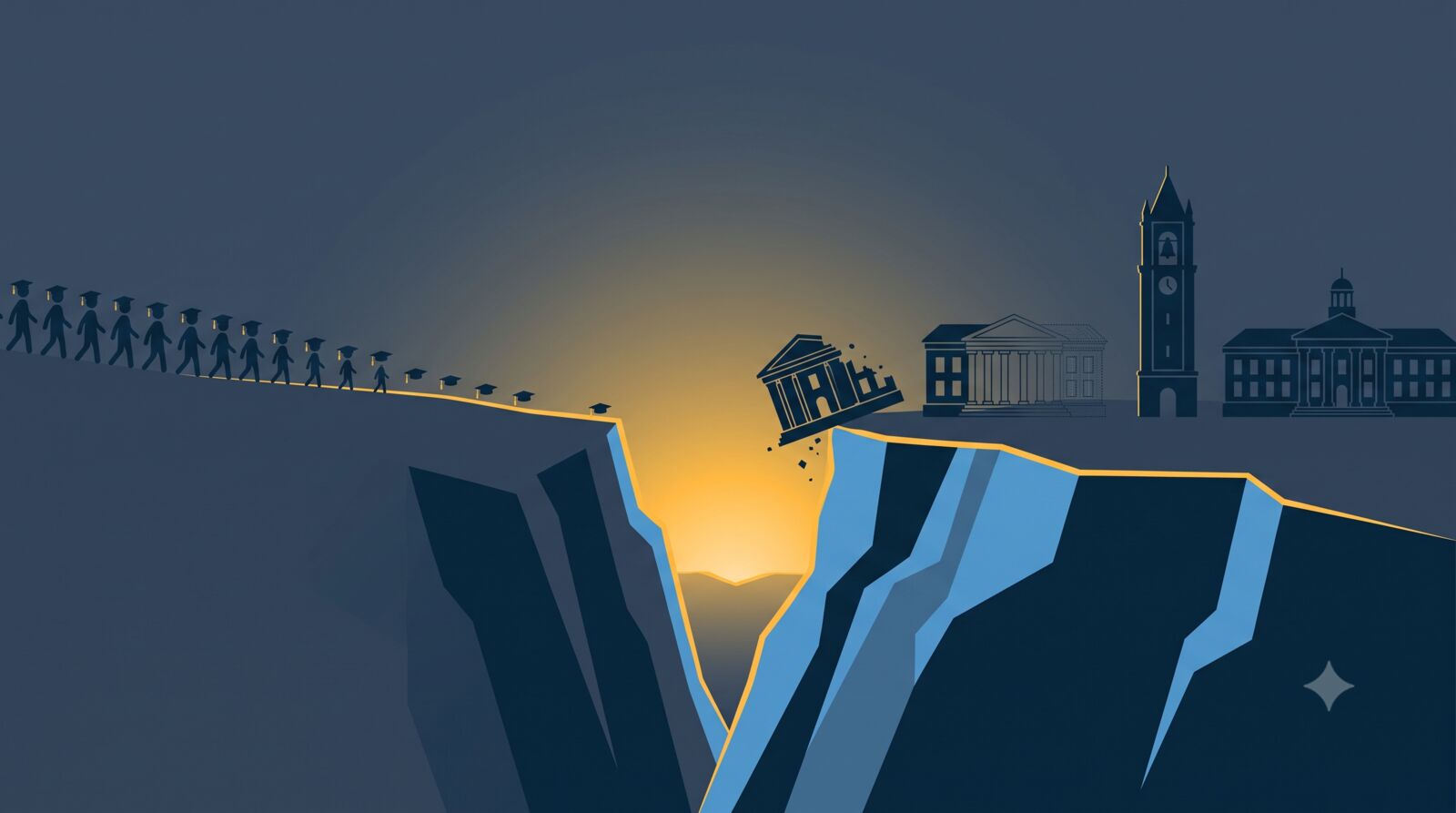
The route itself is a much steeper climb than it looks from the outside. Only about 31.6 percent of students who start at a community college transfer to a four-year school within six years, and researchers at the Community College Research Center have found that roughly 60 percent of students who intend to transfer never actually complete the move. The students who do make it tend to share a specific pattern: banking 30 or more transferable credits in their first year alone puts a student's odds of transferring at 73 percent, more than double the baseline. Patrick, who came away from L.A. Pierce with three associate degrees rather than the one most students aim for, was building exactly that kind of transcript before he ever applied to a four-year school. Research on transfer outcomes backs up why that mattered: students who complete an Associate Degree for Transfer before moving on are roughly 40 percent more likely to actually finish a bachelor's degree than those who transfer without one.
A 4.5 and a One-Way Ticket
By his own account, Patrick "wasn't a successful student" back in Thailand. But he'd decided, for reasons he still can't fully explain, that he wanted to study in the United States. He taught himself English for about a year, sat the IELTS, and landed a 4.5, well below what most four-year US schools expect. What he found instead was a side door: a student visa path built around that score, funneling him into community college rather than directly into a university. He spent three years at L.A. Pierce College, came away with three associate degrees, and transferred into the computer science program at Cal State Northridge (CSUN), later adding double minors in data science and mathematics.
Getting to campus didn't erase the gap. He described arriving with English that was "still like not really good" and having never taken a full academic course load in the language before. The harder problem, once he was there, was math of a different kind: balancing a full course load, a research assistant job in his department, and a NASA-sponsored research position all at once. "I have to learn to prioritize things ruthlessly," he said, "and communicate with both the professors and the supervisors simultaneously."
Fifty Rejections, Then Boracle
That NASA-sponsored position didn't come easily either. Patrick estimates he applied to roughly 50 undergraduate research positions across the country and was turned down by every one. An acceptance finally came through on the last day before the semester started, into a program run by ARCS, the Autonomy Research Center for STEAM (STEM with humanities folded in). The project he landed on, almost by chance, turned out to be the one he calls his most interesting: Boracle.
Boracle is built around wearable devices (smartwatches, smart glasses, headbands, even smart socks and t-shirts) and the mess of inconsistent data they produce. Even two Samsung smartwatches might log heart rate on different intervals, one every 10 minutes and another every 15, and Boracle's broader goal is to normalize that data into one format across hundreds of device makers. The problem Patrick's team is chasing is a real, industry-wide one: an Apple Watch, an Oura Ring, and a WHOOP strap will each report a different heart rate variability number for the same person at the same moment, because every manufacturer runs its own algorithm over a different time window. The closest thing to an agreed-upon fix is a healthcare data standard called HL7 FHIR, which forces every device's raw output into the same labeled format, so a heart rate reading gets tagged identically whether it came from a consumer smartwatch or a hospital monitor. Boracle's work sits squarely inside that unsolved problem, one that has grown more urgent as wearables generate ever more clinically interesting data without a common language for reading it across brands. Patrick's specific piece of it is the IAT, the Intelligence Algorithm team, which takes physiological signals (heart rate, heart rate variability, blood oxygen, sleep) and turns them into usable health predictions. His group has built models for arrhythmia detection, sleep-quality improvement, and injury prediction (soccer among the sports covered); his own lead project is stress detection. Asked to sum up the work in one line, he called it simply "AI and healthcare."
This door has been propping itself open a little wider lately: this same episode's headline segment covered NASA's newly opened Orbit Challenge, which specifically invites community college and university students to commercialize NASA's existing patents. The program, formally called ORBIT (Opportunities in Research, Business, Innovation, and Technology), runs two tracks: one where teams pick an existing NASA-owned patent and pitch a commercial or nonprofit use for it, another where teams design systems aligned with NASA's Artemis moon program. It's open explicitly to community college students alongside university students, offers up to $380,000 in total prizes, and pairs teams with NASA mentors. No Ivy League pedigree required. Patrick's own path, a community college transfer who ended up on a NASA-sponsored research team without ever being recruited through an elite pipeline, is close to a proof of concept for that pitch.
The Lesson That Stuck
The most exciting part of the work, Patrick said, wasn't the conferences or meeting senior NASA staff, though those happened too. It was building something genuinely undirected: real research, without a fixed answer at the end. A conversation with his program's director reframed how he thought about that work. As Patrick recalled it, the director told him bluntly that if an engineering student can't explain their work to other students in terms they understand, the work is useless. He called it harsh but true, and said it pushed him to treat communication as seriously as the technical side, something he thinks a lot of technically strong researchers never bother to develop.
That same instinct shapes how he talks about where AI is headed. His stated goal isn't to build smarter AI for its own sake; it's to work at the intersection of AI, humanities, and learning, on the theory that technology only matters if it serves people rather than replacing how they think.
The Detour Is the Path
Patrick's advice to students graduating this year skipped the usual "learn to code" script. The skill he thinks gets overlooked, he said, is learning how to learn, the meta-skill that lets you pick up whatever comes next once the tools inevitably change again. His second piece of advice was more personal: don't be afraid if your path doesn't look like everyone else's, and don't assume you need it all figured out. He doesn't know what he'll be doing five years from now, and he's fine with that.
"Sometimes the detour is your own path."
He's living that advice right now. Fielding questions about why he isn't just taking a US job and staying, Patrick said he's instead choosing "another crazy path": heading back to Thailand to figure out what's next, the same instinct that got him out of Thailand and into a NASA lab in the first place. It is, in its own way, a continuation of the same pattern that got him this far: a low score, a side door nobody recommends, and a refusal to treat either as the end of the story.