 Students Incorporated
Careers
Be Chanida Left Thai Airways to Paint. The Data Backs Her Up.
Bangkok painter Be Chanida walked away from a stable airline career for art. Recent labor data suggests that leap is less reckless than it looks.
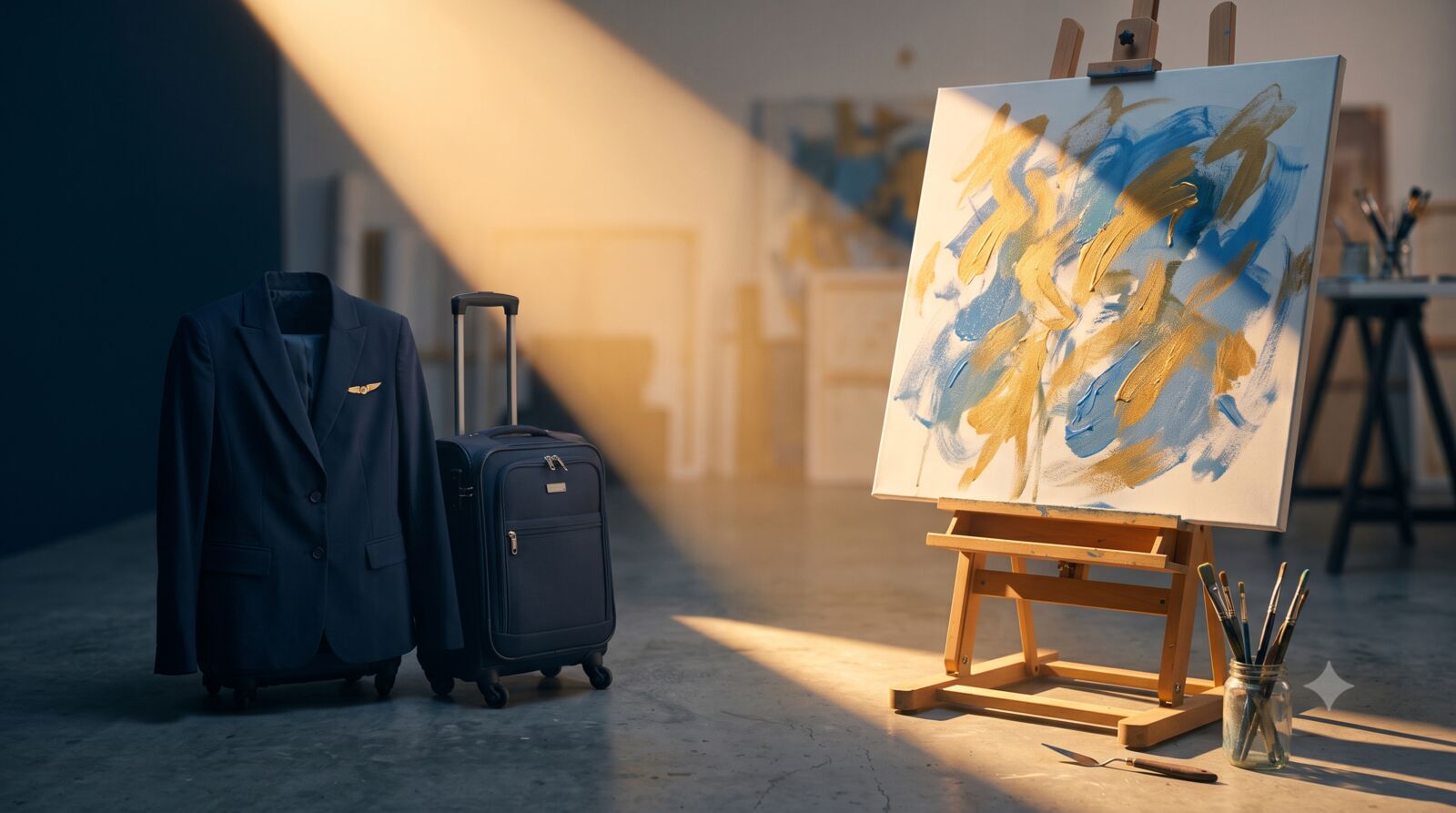
Bangkok painter Be Chanida spent years flying for Thai Airways before she let herself become an artist full-time, and the fear that stopped her for so long is the same one a Students Incorporated co-host raised partway through interviewing her: what if art doesn't pay off? Chanida's own life is a decade-plus argument against waiting to find out, and a look at how arts careers actually perform in the data backs her up more than the stereotype suggests.
Chanida, a self-taught abstract expressionist whose work now hangs in Bangkok hotels and galleries, sat down with the student-run podcast produced by the International Community School of Bangkok for a wide-ranging interview about how she got there. The route was neither fast nor direct, which is what makes it a useful case study for the question a lot of teenagers quietly carry into conversations about what to study and where to work.
A Decade Aloft, Painting on the Side
Chanida didn't start out chasing art. She went to Australia to study English with the specific goal of becoming a flight attendant, and got the job: a long run with Thai Airways that she describes with some ambivalence about its exact length. She cited both seven and twelve years at different points in the conversation, the kind of detail that blurs when someone is narrating a feeling more than a timeline. What's consistent is how she felt inside it. The first two years were fine, she said, but after that "I feel not fit in. I don't feel well." What she did know, even then, was that she was drawn to something most of her colleagues weren't: wherever her flights took her, she ended up in a museum, or photographing an old street, or noticing a city's architecture instead of its shopping.
She started painting seriously during those years, seeking out working Thai artists and, in her words, putting herself in their world, not just their output, but how they lived. She had gallery shows, both group and solo, while still flying full-time. But it stayed a side pursuit, because the airline job was the one that paid.
The Portrait That Brought Her Back
Marriage and motherhood interrupted the practice entirely. Chanida stopped painting for four years after her son was born, treating motherhood, in her telling, as the priority that came before everything else, art included. What pulled her back wasn't a plan. She took a photo of her son one day and had an ordinary thought, that she'd never hung a picture of him on the wall, that nobody really does that anymore, and wondered if she could paint him instead.
She could. More than that, she discovered she could paint portraits at all, a skill she says she never expected to have. Nine years before this conversation, by her account, that discovery became a second career: portrait commissions, paying clients, what she calls her dream come true, because it let her paint every day instead of squeezing it around a flight schedule.
When the Person Disappeared From the Canvas
The portrait phase didn't last as a destination, though it mattered as a bridge. Two or three years in, after her first solo exhibition, Chanida felt she'd said what she had to say through other people's faces. She describes it almost as an outgrowing: "I think that if I remove person from the painting, what's it going to be?" So she removed the person. What followed was a blank canvas and, by her own account, months of not knowing what to put on it: no formal art-school training to fall back on, every canvas functioning as its own lesson. Eventually a loose vocabulary emerged that she calls expressionism, though she resists pinning it down further, describing her method as painting a feeling rather than a form: fuzzy, soft, grounded, translated straight onto canvas without an intermediate plan.
That instinct shows up in one of her recent commissions. Invited to contribute to a themed show at the ART Space by MOCA inside a Four Seasons hotel in Bangkok, Chanida was asked to interpret the idea of longevity. She landed on motherhood as the answer: gold paint and white layered into a piece she describes as a kind of blessing for her son, the same impulse a mother has sending a child out the door safely, translated into pigment. It's a different piece of the same instinct that made her repaint her son's photograph years earlier, using the people closest to her as the surest route to something true on canvas.
The Question Every Art Kid in the Room Was Really Asking
Midway through the interview, co-host Mia turned the conversation personal. She mentioned someone close to her who genuinely loved art but had quit making it in college, convinced it wouldn't lead to an actual job. It's a version of the question Chanida spent a decade sitting with inside a stable airline career, and her answer didn't dodge the tension.
"Commit," she said. "Sometimes goal in your life is just you like it, you love it, you interested in it, but you're not committed. If you commit, you're going to be stuck with it. Right? And if you are an artist, you're still an artist." She drew a distinction between art as a job title and art as an identity that persists regardless of what pays the bills in a given year: "if you work as an accountant, you may be a doctor, but you're an artist... it's not a career. It's life." She was candid, too, about what committing cost her in practice: by her account, she spent years painting at home in tears every time Thai Airways called her in to fly, unable to walk away yet, unwilling to stop painting either.
You're not going to regret when you're getting old that you never try.
What the Numbers Actually Say
The fear behind Mia's question, that choosing art is choosing financial risk, is common enough to be treated as common sense. Recent labor data complicates it. A Federal Reserve Bank of New York analysis of 2023 Census figures, reported by CNBC in May 2025, found that art history graduates had a 3 percent unemployment rate, lower than finance majors at 3.7 percent and roughly half the rate for computer science and computer engineering graduates, who came in at 6.1 percent and 7.5 percent respectively. Art history was not the study's standout best-performing major (nutrition science, at 0.4 percent, held that spot) but it beat several degrees popularly assumed to be the "safe" choice.
A separate 2024 report from the Strategic National Arts Alumni Project, a research partnership between the University of Texas at Austin and the University of Illinois Urbana-Champaign that has surveyed tens of thousands of arts and design graduates, found that 92 percent of arts alumni were employed, with about 65 percent working in arts-related fields and roughly three-quarters saying their current job was directly connected to their training. None of that guarantees any individual artist a living, and it doesn't erase the real financial uncertainty of freelance and commission-based work. But it undercuts the assumption, embedded in Mia's question, that pursuing art is a uniquely reckless bet compared with more conventional majors.
Chanida's own path fits uneasily into either the myth or the data point, which may be the more honest lesson. She didn't skip the safe option; she held it for years, painting in the margins, before deciding the margins weren't enough. What the interview captures isn't a clean story about talent finding its way, but a slower one about someone who kept the parachute of a stable job as long as she needed it and still, eventually, let it go. It's advice she now hands to students who ask her the same question she once asked herself, minus the tears at the airport gate.